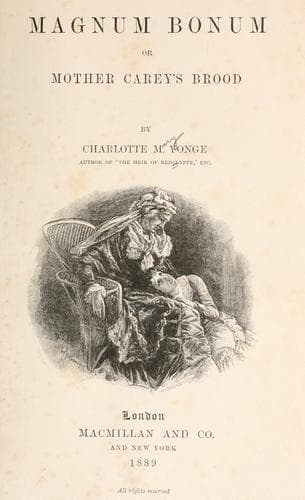
Magnum Bonum; Or, Mother Carey's BroodYonge, Charlotte M. (Charlotte Mary)
General
Magnum Bonum; Or, Mother Carey's Brood
Yonge, Charlotte M. (Charlotte Mary)
Domestic fiction; England -- Social life and customs -- 19th century -- Fiction; Religious fiction
On the family vote, Caroline rather unwillingly wrote a note, explaining
that she had only just discovered her kinship with Mr. Barnes, and
offering to come and see him; but not the smallest notice was taken of
her letter, rather to her relief, though she did not like to hear Ellen
augur ill for the future.
Another letter, to old Mr. Gould, begging him to call upon her next
market day, met with a far more ready response. When at his entrance she
greeted him with outstretched hands, and--“I never thought you were a
connection;” the fine old weather-beaten face was strangely moved, as
the rugged hand took hers, and the voice was husky that said--
“I thought there was a likeness in the voice, but I never imagined you
were grandchild to poor Carey Barnes; I beg your pardon, to Mrs. Otway.”
“You knew her? You must let me see something of my little cousin! I know
nothing of my relations and my brother-in-law said he thought you could
tell me.”
“I ought to be able, for the family lived at Woodbridge all my young
days,” said the farmer.
The history was then given. The present lord of the manor had been the
son of a land surveyor. He was a stunted, sickly, slightly deformed lad,
noted chiefly for skill in cyphering, and therefore had been placed in
a clerkship. Here a successful lottery ticket had been the foundation of
his fortunes; he had invested it in the mahogany trade, and had been one
of those men with whom everything turned up a prize. When a little over
thirty, he had returned to his own neighbourhood, looking any imaginable
age. He had then purchased Belforest, furnished it sumptuously, and laid
out magnificent gardens in preparation for his bride, a charming young
lady of quality. But she had had a young Lochinvar, and even in her
wedding dress, favoured by sympathising servants, had escaped down the
back stairs of a London hotel, and been married at the nearest Church,
leaving poor Mr. Barnes in the case of the poor craven bridegroom, into
whose feelings no one ever inquired.
Mr. Barnes had gone back to the West Indies at once, and never appeared
in England again till he came home, a broken and soured old man, to die.
There had been two sisters, and Caroline fancied that the old farmer had
had some tenderness for the elder one, but she had married, before
her brother’s prosperity, a poor struggling builder, and both had died
young, leaving their child dependent on her uncle. His younger sister
had been the favourite; he had taken her back with him to America, and,
married her to a man of Spanish blood, connected with him in business.
The only one of her children who survived childhood was educated
in England, treated as his uncle’s heir, and came to Belforest for
shooting. Thus it was that he had fallen in love with Farmer Gould’s
pretty daughter, and as it seemed, by her mother’s contrivance, though
without her father’s consent, had made her his wife.
Public-domain text, read in full here on John Shaqi.
Reviews
Reviews
No reviews yet
Be the first to share your thoughts on this work.
Elsewhere in the archive
Join the Discussion
Join the discussion
Sign in to leave a comment or review.
Sign InorCreate an account