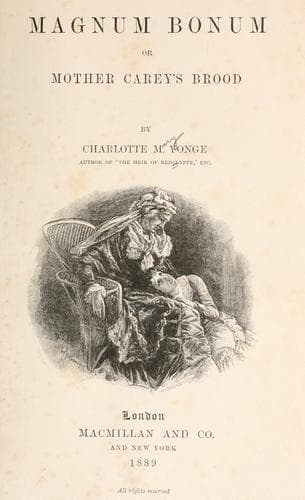
Magnum Bonum; Or, Mother Carey's BroodYonge, Charlotte M. (Charlotte Mary)
General
Magnum Bonum; Or, Mother Carey's Brood
Yonge, Charlotte M. (Charlotte Mary)
Domestic fiction; England -- Social life and customs -- 19th century -- Fiction; Religious fiction
The wrath of Mr. Barnes was implacable. He cast off the favourite nephew
as entirely as he had cast off the despised niece, and deprived him of
all the means he had been led to look on as his right. The young man had
nothing of his own but an estate in the small island of San Ildefonso,
of very little value, and some of his former friends made interest to
obtain a vice-consulship for him at the Spanish town. Then, after a few
years, both husband and wife died, leaving this little orphan to the
care of her grandfather, who had written to Mr. Barnes on her father’s
death, but had heard nothing from him, and had too much honest pride to
make any further application.
“My little cousin,” said Caroline, “the first I ever knew. Pray bring
her to see me, and let her stay with me long enough for me to know her.”
The old man began to prepare her for the child’s being shy and wild,
though perhaps her aunt was too particular with her, and expected too
much. Perhaps she would be homesick, he said, so wistfully that it was
plain that he did not know how to exist without his darling; but he was
charmed with the invitation, and Caroline was pleased to see that he
did not regard her as his grandchild’s rival, but as representing the
cherished playmate of his youth.
CHAPTER XIII. -- THE RIVAL HEIRESSES.
You smile, their eager ways to see,
But mark their choice when they
To choose their sportive garb are free,
The moral of their play.
Keble.
One curious part of the reticence of youth is that which relates to
its comprehension of grown-up affairs. There is a smile with which
the elders greet any question on the subject, half of wonder, half
of amusement, which is perfectly intolerable to the young, who remain
thinking that they are regarded as presumptuous and absurd, and thus
will do anything rather than expose themselves to it again.
Thus it was that Mrs. Brownlow flattered herself that her children never
put two and two together when she let them know of the discovery of
their relationship. Partly she judged by herself. She was never in
the habit of forecasting, and for so clever and spirited a woman, she
thought wonderfully little. She had plenty of intuitive sense, decided
rapidly and clearly, and could easily throw herself in other people’s
thoughts, but she seldom reflected, analysed or moralised, save on the
spur of the moment. She lived chiefly in the present, and the chief
events of her life had all come so suddenly and unexpectedly upon her,
that she was all the less inclined to guess at the future, having always
hitherto been taken by surprise.
So, when Jock observed in public--“Mother, they say at Kencroft that the
old miser ought to leave you half his money. Do you think he will?” it
was with perfect truth that she answered, “I don’t think at all about
it.”
Public-domain text, read in full here on John Shaqi.
Reviews
Reviews
No reviews yet
Be the first to share your thoughts on this work.
Elsewhere in the archive
Join the Discussion
Join the discussion
Sign in to leave a comment or review.
Sign InorCreate an account