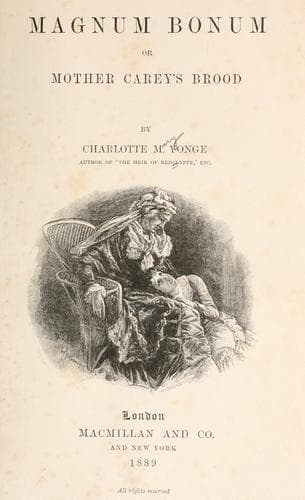
Magnum Bonum; Or, Mother Carey's BroodYonge, Charlotte M. (Charlotte Mary)
General
Magnum Bonum; Or, Mother Carey's Brood
Yonge, Charlotte M. (Charlotte Mary)
Domestic fiction; England -- Social life and customs -- 19th century -- Fiction; Religious fiction
“O yes, I know. But that I should have turned against him!” And Jessie
was so thoroughly unhappy that none of her lessons prospered and her
German exercise had three great tear blots on it.
Rob’s second misdemeanour had simplified matters by deciding his father
on sending him from home at once into the hands of a professed coach,
who would not let him elude study, and whose pupils were too big to
be bullied. To the last he maintained his sullen dogged air of
indifference, though there might be more truth than the Folly was
disposed to allow in his sister’s allegations that it was because he did
feel it so very much, especially mamma’s looking so ill and worried.
Ellen did in truth look thoroughly unhinged, though no one saw her give
way. She felt her boy’s conduct sorely, and grieved at the first parting
in her family. Besides, there was anxiety for the future. Rob’s manner
of conducting his studies was no hopeful augury of his success, and
the expenses of sending him to a tutor fell the more heavily because
unexpectedly. A horse and man were given up, and Jessie had to resign
the hope of her music lessons. These were the first retrenchments, and
the diminution of dignity was felt.
The Colonel showed his trouble and anxiety by speaking and tramping
louder than ever, ruling his gardener with severe precision, and
thundering at his boys whenever he saw them idle. Both he and his wife
were so elaborately kind and polite that Caroline believed that it was
an act of magnanimous forgiveness for the ill luck that she and her
boys had brought them. At last the Colonel had the threatened fit of the
gout, which restored his equilibrium, and brought him back to his usual
condition of kindly, if somewhat ponderous, good sense.
He had not long recovered before Number Nine made his appearance at
Kencroft, and thus his mother had unusual facilities for inquiries of
Dr. Leslie respecting the master of Belforest.
The old man really seemed to be in a dying state. A hospital nurse had
taken charge of him, but there was not a dependent about the place, from
Mr. Richards downwards, who was not under notice to quit, and most were
staying on without his knowledge on the advice of the London solicitor,
to whom the agent had written. There was even more excitement on the
intelligence that Mr. Barnes had sent for Farmer Gould.
On this there was no doubt, for Mr. Gould, always delicately honourable
towards Mrs. Brownlow, came himself to tell her about the interview. It
seemed to have been the outcome of a yearning of the dying man towards
the sole survivor of the companions of his early days. He had talked
in a feeble wandering way of old times, but had said nothing about the
child, and was plainly incapable of sustained attention.
He had asked Mr. Gould to come again, but on this second visit he was
too far gone for recognition, and had returned to his moody instinctive
aversion to visitors, and in three days more he was dead.
Public-domain text, read in full here on John Shaqi.
Reviews
Reviews
No reviews yet
Be the first to share your thoughts on this work.
Elsewhere in the archive
Join the Discussion
Join the discussion
Sign in to leave a comment or review.
Sign InorCreate an account