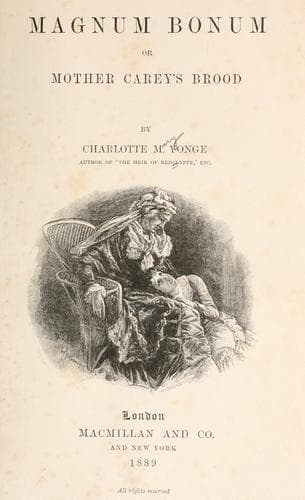
Magnum Bonum; Or, Mother Carey's BroodYonge, Charlotte M. (Charlotte Mary)
General
Magnum Bonum; Or, Mother Carey's Brood
Yonge, Charlotte M. (Charlotte Mary)
Domestic fiction; England -- Social life and customs -- 19th century -- Fiction; Religious fiction
CHAPTER XV. -- THE BELFOREST MAGNUM BONUM.
Where is his golden heap?
Divine Breathings.
Mrs. Robert Brownlow was churched with all the expedition possible, in
order that she might not lose the sight of the funeral procession, which
would be fully visible from the studio in the top of the tower.
The excitement was increased by invitations to attend the funeral being
sent to the Colonel and to his two eldest nephews, who were just
come home for the holidays, also to their mother to be present at the
subsequent reading of the will.
A carriage was sent for her, and she entered it, not knowing or caring
to find out what she wished, and haunted by the line, “Die and endow a
college or a cat.”
Allen met her at the front door, whispering--“Did you see, mother, he
has still got his ears?” And the thought crossed her--“Will those ears
cost us dear?”
She was the only woman present in the library--a large room, but with
an atmosphere as if the open air had not been admitted for thirty years,
and with an enormous fire, close to which was the arm-chair whither she
was marshalled, being introduced to the two solicitors, Mr. Rowse and
Mr. Wakefield, who, with Farmer Gould, the agent, Richards, the Colonel,
and the two boys, made up the audience.
The lawyers explained that the will had been sent home ten years ago
from Yucatan, and had ever since been in their hands. Search had been
made for a later one, but none had been found, nor did they believe that
one could exist.
It was very short. The executors were Charles Rowse and Peter Ball, and
the whole property was devised to them, and to Lieutenant-Colonel Robert
Brownlow, as trustees for the testator’s great-niece, Mrs. Caroline
Otway Brownlow, daughter of John and Caroline Allen, and wife of Joseph
Brownlow, Esq., M.D., F.R.C.S., the income and use thereof to be enjoyed
by her during her lifetime; and the property, after her death, to be
divided among her children in such proportions as she should direct.
That was all; there was no legacy, no further directions.
“Allow me to congratulate--” began the elder lawyer.
“No--no--oh, stay a bit,” cried she, in breathless dismay and
bewilderment. “It can’t be! It can’t mean only me. There must be
something about Elvira de Menella.”
“I fear there is not,” said Mr. Rowse; “I could wish my late client had
attended more to the claims of justice, and had divided the property,
which could well have borne it; but unfortunately it is not so.”
“It is exactly as he led us to expect,” said Mr. Gould. “We have no
right to complain, and very likely the child will be much happier
without it. You have a fine family growing up to enjoy it, Mrs.
Brownlow, and I am sure no one congratulates you more heartily than I.”
“Don’t; it can’t be,” cried the heiress, nearly crying, and wringing the
old farmer’s hand. “He must have meant Elvira. You know he sent for you.
Has everything been hunted over? There must be a later will.”
Public-domain text, read in full here on John Shaqi.
Reviews
Reviews
No reviews yet
Be the first to share your thoughts on this work.
Elsewhere in the archive
Join the Discussion
Join the discussion
Sign in to leave a comment or review.
Sign InorCreate an account