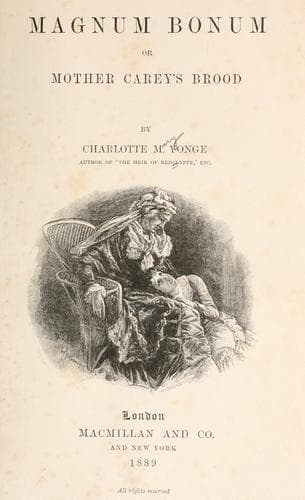
Magnum Bonum; Or, Mother Carey's BroodYonge, Charlotte M. (Charlotte Mary)
General
Magnum Bonum; Or, Mother Carey's Brood
Yonge, Charlotte M. (Charlotte Mary)
Domestic fiction; England -- Social life and customs -- 19th century -- Fiction; Religious fiction
However, at last her brother-in-law put her into the brougham, desiring
the boys to walk home, which they did very willingly, and with a
wonderful air of lordship and possession.
“Well, Caroline,” said the Colonel, “I congratulate you on being the
richest proprietor in the county.”
“O Robert, don’t! If--if,” said a suffocated voice, so miserable that he
turned and took her hand kindly, saying--
“My dear sister, this feeling is very--it becomes you well. This is a
fearful responsibility.”
She could not answer. She only leant back in the carriage, with closed
eyes, and moaned--
“Oh! Joe! Joe!”
“Indeed,” said his brother, greatly touched, “we want him more than
ever.”
He did not try to talk any more to her, and when they reached the
Pagoda, all she could do was to hurry up stairs, and, throwing off her
bonnet, bury her face in the pillow.
Janet and her aunt both followed, the latter with kind and tender
solicitude; but Caroline could bear nothing, and begged only to be left
alone.
“Dear Ellen, it is very kind, but nothing does any good to these
headaches. Please don’t--please leave me alone.”
They saw it was the only true kindness, and left her, after all attempts
at bathing her forehead, or giving her sal volatile, proved only to
molest her. She lay on her bed, not able to think, and feeling nothing
but the pain of her headache and a general weight and loneliness.
The first break was from Allen, who came in tenderly with a cup of
coffee, saying that they thought her time was come for being ready for
it. His manner always did her good, and she sat up, pushed back her
hair, smiled, took the cup, and thanked him lovingly.
“Uncle Robert is waiting to hear if you are better,” he said.
“Oh yes,” she said; “thank him; I am sorry I was so silly.”
“He wants me to dine there to-night, mother, to meet Mr. Rowse and Mr.
Wakefield,” said Allen, with a certain importance suited to a lad of
fifteen, who had just become “somebody.”
“Very well,” she said, in weary acquiescence, as she lay down again,
just enough refreshed by the coffee to become sleepy.
“And mother,” said Allen, lingering in the dark, “don’t trouble about
Elfie. I shall marry her as soon as I am of age, and that will make all
straight.”
Her stunned sleepiness was scarcely alive to this magnanimous
announcement, and she dreamily said--
“Time enough to think of such things.”
“I know,” said Allen; “but I thought you ought to know this.”
Public-domain text, read in full here on John Shaqi.
Reviews
Reviews
No reviews yet
Be the first to share your thoughts on this work.
Elsewhere in the archive
Join the Discussion
Join the discussion
Sign in to leave a comment or review.
Sign InorCreate an account