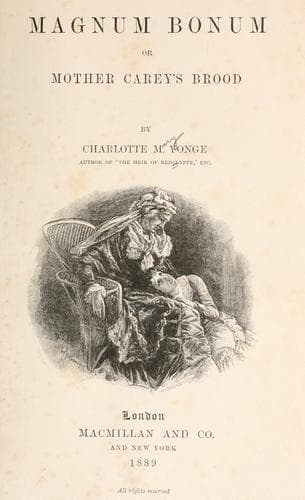
Magnum Bonum; Or, Mother Carey's BroodYonge, Charlotte M. (Charlotte Mary)
General
Magnum Bonum; Or, Mother Carey's Brood
Yonge, Charlotte M. (Charlotte Mary)
Domestic fiction; England -- Social life and customs -- 19th century -- Fiction; Religious fiction
He looked wistfully for another word on this great avowal, but she was
really too much stupefied to enter into the purport of the boy’s words,
and soon after he left her she fell sound asleep. She had a curious
dream, which she remembered long after. She seemed to have identified
herself with King Midas, and to be touching all her children, who
turned into hard, cold, solid golden statues fixed on pedestals in the
Belforest gardens, where she wandered about, vainly calling them. Then
her husband’s voice, sad and reproachful, seemed to say, “Magnum Bonum!
Magnum Bonum!” and she fancied it the elixir which alone could restore
them, and would have climbed a mountain in search of it, as in the
Arabian tale; but her feet were cold, heavy, and immovable, and she
found that they too had become gold, and that the chill was creeping
upwards. With a scream of “Save the children, Joe,” she awoke.
No wonder she had dreamt of cold golden limbs, for her feet were really
chilly as ice, and the room as dark as at midnight. However it was not
yet seven o’clock; and presently Janet brought a light, and persuaded
her to come downstairs and warm herself. She was not yet capable of
going into the dining-room to the family tea, but crept down to lie
on the sofa in the drawing-room; and there, after taking the small
refreshment which was all she could yet endure, she lay with closed
eyes, while the children came in from the meal. Armine and Babie were
the first. She knew they were looking at her, but was too weary to exert
herself to speak to them.
“Asleep,” they whispered. “Poor Mother Carey.”
“Armie,” said Babie, “is mother unhappy because she has got rich?”
Armine hesitated. His brief experience of school had made him less
unsophisticated, and he seldom talked in his own peculiar fashion even
to his little sister, and she added--
“Must people get wicked when they are rich?”
“Mother is always good,” said faithful little Armine.
“The rich people in the Bible were all bad,” pondered Babie. “There was
Dives, and the man with the barns.”
“Yes,” said Armine; “but there were good ones too--Abraham and Solomon.”
“Solomon was not always good,” said Babie; “and Uncle Robert told Allen
it was a fearful responsibility. What is a responsibility, Armie? I am
sure Ali didn’t like it.”
“Something to answer for!” said Armine.
“To who?” asked the little girl.
“To God,” said the boy reverently. “It’s like the talent in the parable.
One has got to do something for God with it, and then it won’t turn to
harm.”
“Like the man’s treasure that changed into slate stones when he made a
bad use of it,” said Babie. “Oh! Armie, what shall we do? Shall we give
plum-puddings to the little thin girls down the lane?”
“And I should like to give something good to the little grey workhouse
boys,” said Armine. “I should so hate always walking out along a
straight road as they do.”
“And oh! Armie, then don’t you think we may get a nice book to write out
Jotapata in?”
Public-domain text, read in full here on John Shaqi.
Reviews
Reviews
No reviews yet
Be the first to share your thoughts on this work.
Elsewhere in the archive
Join the Discussion
Join the discussion
Sign in to leave a comment or review.
Sign InorCreate an account