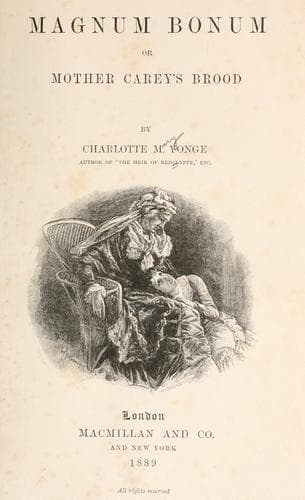
Magnum Bonum; Or, Mother Carey's BroodYonge, Charlotte M. (Charlotte Mary)
General
Magnum Bonum; Or, Mother Carey's Brood
Yonge, Charlotte M. (Charlotte Mary)
Domestic fiction; England -- Social life and customs -- 19th century -- Fiction; Religious fiction
“Hardly, for see here, I found a letter from Acton when I came in.
They have found an unsophisticated elysium at Kyve Clements, and are in
raptures which they want us to share--rocks and waves and all.”
“And rooms?”
“Yes, very good rooms, enough for us all,” was the answer, flinging
into her lap a letter from his friend, a somewhat noted artist in
water-colours, whom, after long patience, Carey’s school friend, Miss
Cartwright, had married two years ago.
There was nothing to say against it, only grandmamma observed, “I am too
old to catch things; Joe will let me stay and keep house for him.”
“Please, please let me stay with granny,” insisted Janet; “then I shall
finish my German classes.”
Janet was granny’s child. She had slept in her room ever since Allen
was born, and trotted after her in her “housewifeskep,” and the sense
of being protected was passing into the sense of protection. Before she
could be answered, however, there was an announcement. Friends were apt
to drop in to coffee and talk in the evening, on the understanding that
certain days alone were free--people chiefly belonging to a literary,
scientific, and artist set, not Bohemian, but with a good deal of quiet
ease and absence of formality.
This friend had just returned from Asia Minor, and had brought an
exquisite bit of a Greek frieze, of which he had become the happy
possessor, knowing that Mrs. Joseph Brownlow would delight to see it,
and mayhap to copy it.
For Carey’s powers had been allowed to develop themselves; Mrs. Brownlow
having been always housekeeper, she had been fain to go on with the
studies that even her preparation for governess-ship had not rendered
wearisome, and thus had become a very graceful modeller in clay--her
favourite pursuit--when her children’s lessons and other occupations
left her free to indulge in it. The history of the travels, and the
account of the discovery, were given and heard with all zest, and in the
midst others came in--a barrister and his wife to say good-bye before
the circuit, a professor with a ticket for the gallery at a scientific
dinner, two medical students, who had been made free of the house
because they were nice lads with no available friends in town.
It was all over by half-past ten, and the trio were alone together.
“How amusing Mr. Leslie is!” said the young Mrs. Brownlow. “He knows how
describe as few people do.”
“Did you see Janet listening to him,” said her grandmother, “with her
brows pulled down and her eyes sparkling out under them, wanting to
devour every word?”
“Yes,” returned the Doctor, “I saw it, and I longed to souse that
black head of hers with salt water. I don’t like brains to grow to the
contempt of healthful play.”
“People never know when they are well off! I wonder what you would have
said if you had had a lot of stupid dolts, boys always being plucked,
&c.”
“Don’t plume yourself too soon, Mother Carey; only one chick has gone
through the first ordeal.”
“And if Allen did, Bobus will.”
Public-domain text, read in full here on John Shaqi.
Reviews
Reviews
No reviews yet
Be the first to share your thoughts on this work.
Join the Discussion
Join the discussion
Sign in to leave a comment or review.
Sign InorCreate an account