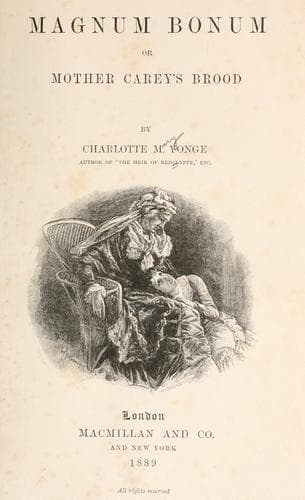
Magnum Bonum; Or, Mother Carey's BroodYonge, Charlotte M. (Charlotte Mary)
General
Magnum Bonum; Or, Mother Carey's Brood
Yonge, Charlotte M. (Charlotte Mary)
Domestic fiction; England -- Social life and customs -- 19th century -- Fiction; Religious fiction
She had no time to think or feel till she had reached the train and
taken her seat, and even then the first thing she was conscious of was
a sense of numbness within, and frivolous observation without, as she
found herself trying to read upside down the direction of her opposite
neighbour’s parcels, counting the flounces on her dress, and speculating
on the meetings and partings at the stations; yet with a terrible weight
and soreness on her all the time, though she could not think of the dear
grannie, of whom it was no figure of speech to say that she had been
indeed a mother. The idea of her absence from home for ever was too
strange, too heartrending to be at once embraced, and as she neared the
end of her journey on that long day, Carey’s mind was chiefly fixed on
the yearning to be with her husband and Janet, who had suffered such a
shock without her. She seemed more able to feel through her husband--who
was so devoted to his mother, than for herself, and she was every moment
more uneasy about her little daughter, who must have been in the room
with her grandmother. Comfort them? How, she did not know! The others
had always petted and comforted her, and now--No one to go to when the
children were ailing or naughty--no one to share little anxieties
when Joe was out late--no one to be the backbone she leant on--no dear
welcome from the easy chair. That thought nearly set her crying; the
tears burnt in her strained eyes, but the sight of the people opposite
braced her, and she tried to fix her thoughts on the unseen world, but
they only wandered wide as if beyond her own control, and her head was
aching enough to confuse her.
At last, late on the long summer day, she was at the terminus, and with
a heart beating so fast that she could hardly breathe, found herself in
a cab, driving up to her own door, just as the twilight was darkening.
How dark it looked within, with all the blinds down! The servant who
opened the door thought Miss Janet was in the drawing-room, but the
master was out. It sounded desolate, and Carey ran up stairs, craving
and eager for the kiss of her child--the child who must have borne the
brunt of the shock.
The room was silent, all dusky and shadowed; the window-frames were
traced on the blinds by the gas freshly lighted outside, and moving in
the breeze with a monotonous dreariness. Carey stood a moment, and then
her eyes getting accustomed to the darkness, she discerned a little
heap lying curled up before the ottoman, her head on a great open book,
asleep--poor child! quite worn out. Carey moved quietly across and sat
down by her, longing but not daring to touch her. The lamp was brought
up in a minute or two, and that roused Janet, who sprang up with a
sudden start and dazzled eyes, exclaiming “Father! Oh, it’s Mother
Carey! Oh, mother, mother, please don’t let him go!”
“And you have been all alone in the house, my poor child,” said Carey,
as she felt the girl shuddering in her close embrace.
Public-domain text, read in full here on John Shaqi.
Reviews
Reviews
No reviews yet
Be the first to share your thoughts on this work.
Join the Discussion
Join the discussion
Sign in to leave a comment or review.
Sign InorCreate an account