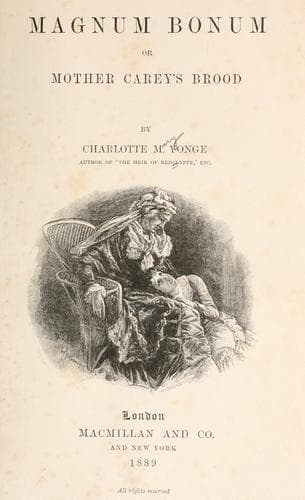
Magnum Bonum; Or, Mother Carey's BroodYonge, Charlotte M. (Charlotte Mary)
General
Magnum Bonum; Or, Mother Carey's Brood
Yonge, Charlotte M. (Charlotte Mary)
Domestic fiction; England -- Social life and customs -- 19th century -- Fiction; Religious fiction
The arrangement was not to Janet’s taste. She thought herself perfectly
capable of escorting the younger ones, especially as they were to take
their maid, a capable person named Delrio, daughter of an Englishwoman
and a German waiter, and widow of an Italian courier, who was equal to
all land emergencies, and could speak any language. She belonged to the
young ladies. Their mother, not liking strangers about her, had, on old
nurse’s death, caused Emma to learn enough of the lady’s maid’s art for
her own needs at home, and took care of herself abroad.
Babie was enraptured to be going to Mother Carey and Armine, and Elvira
was enchanted to leave the schoolroom behind her, being fully aware that
she always had more notice and indulgence from outsiders than at home,
or indeed from anyone who had been disappointed at her want of all real
affection.
“You are just like a dragon fly,” said Babie to her; “all brightness
outside and nothing within.”
This unusually severe remark came from Babie’s indignation at Elvira’s
rebellion against going to River Hollow to take leave. It would be a
melancholy visit, for her grandfather had become nearly imbecile since
he had had a paralytic stroke, in the course of the winter, and good
sensible Mrs. Gould had died of fever in the previous autumn.
Elvira, who had never liked the place, now loathed it, and did not seem
capable of understanding Babie’s outburst.
“Not like to go and see them when they are ill and unhappy! Elfie, how
can you?”
“Of course I don’t! Grandpapa kisses me and makes me half sick.”
“But he is so fond of you.”
“I wish he wasn’t then. Why, Babie, are you going to cry? What’s the
matter?”
“It is very silly,” said Babie, winking hard to get rid of her tears;
“but it does hurt me so to think of the good old gentleman caring more
for you than anybody, and you not liking to go near him.”
“I can’t see what it matters to you,” said Elvira; “I wish you would go
instead of me, if you are so fond of him.”
“He wouldn’t care for me,” said Babie; “I’m not his ain lassie.”
“_His_ lassie! I’m a lady,” exclaimed the senorita, with the haughty
Spanish turn of the neck peculiar to herself.
“That’s not what I mean by a lady,” said Babie.
“What do you mean by it?” said Elvira, with a superior air.
“One who never looks down on anybody,” said Babie, thoughtfully.
“What nonsense!” rejoined the Elf; “as if any lady could like to hear
grandpapa maunder, and Mary scold and scream at the farm people, just
like the old peahen.”
“Miss Ogilvie said poor Mary was overstrained with having more to attend
to than she could properly manage, and that made her shrill.”
“I know it makes her very disagreeable; and so they all are. I hate the
place, and I don’t see why I should go,” grumbled Elvira.
“You will when you are older, and know what proper feeling is,” said
Miss Ogilvie, who had come within earshot of the last words. “Go and put
on your hat; I have ordered the pony carriage.”
Public-domain text, read in full here on John Shaqi.
Reviews
Reviews
No reviews yet
Be the first to share your thoughts on this work.
Elsewhere in the archive
Join the Discussion
Join the discussion
Sign in to leave a comment or review.
Sign InorCreate an account