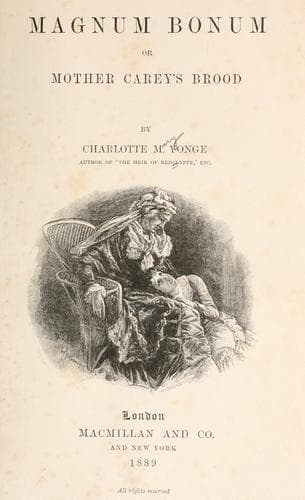
Magnum Bonum; Or, Mother Carey's BroodYonge, Charlotte M. (Charlotte Mary)
General
Magnum Bonum; Or, Mother Carey's Brood
Yonge, Charlotte M. (Charlotte Mary)
Domestic fiction; England -- Social life and customs -- 19th century -- Fiction; Religious fiction
“Shall I go, Miss Ogilvie?” asked Babie, as Elfie marched off sullenly,
since her governess never allowed herself to be disobeyed.
“I think I had better go, my dear; Elfie may be under more restraint
with me.”
“Please give old Mr. Gould and Mary and Kate my love, and I will run
and ask for some fruit for you to take to them,” said Babie, her tender
heart longing to make compensation.
Miss Ogilvie and her pouting companion were received by a
fashionable--nay, extra fashionable--looking person, whom Mary and Kate
Gould called Cousin Lisette, and the old farmer, Eliza Gould. While the
old man in his chair in the sun in the hot little parlour caressed, and
asked feeble repetitions of questions of his impatient granddaughter,
the lady explained that she had thrown up an excellent situation as
instructress in a very high family to act in the same capacity to her
motherless little cousins. She professed to be enchanted to meet Miss
Ogilvie, and almost patronised.
“I know what the life is, Miss Ogilvie, and how one needs companionship
to keep up one’s spirits. Whenever you are left alone, and would drop me
a line, I should be quite delighted to come and enliven you; or whenever
you would like to come over here, there’s no interruption by uncle; and
he, poor old gentleman, is quite--quite passe. The children I can always
dismiss. Regularity is my motto, of course, but I consider that an
exception in favour of my own friends does no harm, and indeed it is no
more than I have a right to expect, considering the sacrifices that I
have made for them. Mary, child, don’t cross your ankles; you don’t see
your cousin do that. Kate, you go and see what makes Betsy so long in
bringing the tea. I rang long ago.”
“I will go and fetch it,” said Mary, an honest, but harassed-looking
girl.
“Always in haste,” said Miss Gould, with an effort at good humour,
which Miss Ogilvie direfully mistrusted. “No, Mary, you must remain
to entertain your cousin. What are servants for but to wait on us? She
thinks nothing can be done without her, Miss Ogilvie, and I am forced to
act repression sometimes.”
“Indeed we do not wish for any tea,” said Miss Ogilvie, seeing Elvira
look as black as thunder; “we have only just dined.”
“But Elfie will have some sweet-cake; Elfie likes auntie’s sweet-cake,
eh?” said the old man.
“No, thank you,” said Elfie, glumly, though in fact she did care
considerably for sweets, and was always buying bonbons.
“No cake! Or some strawberries--strawberries and cream,” said her
grandfather. “Mr. Allen always liked them. And where is Mr. Allen now,
my dear?”
“Gone to Norway. It’s the fifth time I’ve told him so,” muttered Elvira.
“And where is Mr. Robert? And Mr. Lucas?” he went on. “Fine young
gentlemen all of them; but Mr. Allen is the pleasant-spoken one. Ain’t
he coming down soon? He always looks in and says, ‘I don’t forget your
good cider, Mr. Gould,’” and there was a feeble chuckling laugh and old
man’s cough.
Public-domain text, read in full here on John Shaqi.
Reviews
Reviews
No reviews yet
Be the first to share your thoughts on this work.
Elsewhere in the archive
Join the Discussion
Join the discussion
Sign in to leave a comment or review.
Sign InorCreate an account