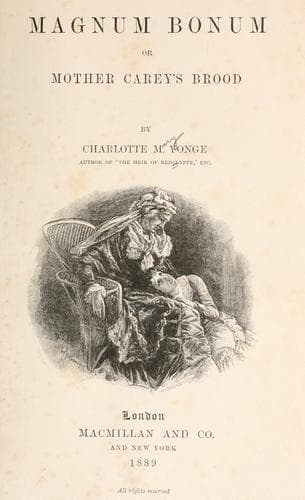
Magnum Bonum; Or, Mother Carey's BroodYonge, Charlotte M. (Charlotte Mary)
General
Magnum Bonum; Or, Mother Carey's Brood
Yonge, Charlotte M. (Charlotte Mary)
Domestic fiction; England -- Social life and customs -- 19th century -- Fiction; Religious fiction
The word “happy,” was so genuine, and the speech so comical, that the
Editor had much ado to keep his countenance as he gave considerable
hopes that the serial element should be thus supplied in the MS.
magazine.
Meantime, the two mothers were walking about and resting together,
keeping their young people in some degree in view, and discussing at
first the subject most on their minds, their sons’ bodily health, and
the past danger, for which Caroline found a deeply sympathetic listener,
and one who took a hopeful view of Armine.
Mrs. Evelyn was indeed naturally disposed to augur well whenever the
complaint was not hereditary, and she was besides in excellent spirits
at the very visible progress of both her sons, the one in physical,
the other in moral health, and she could not but attribute both to the
companionship that she had been so anxious to prevent. She had never
seen Duke look so well, nor seem so free from languor and indifference
since he was a mere child, and all seemed due to his devotion to Armine;
while as to Cecil, he seemed to have a new spring of improvement, which
he ascribed altogether to his friend.
“It is strange to me to hear this of my poor Jock,” said Caroline,
“always my pickle and scapegrace, though he is a dear good-hearted boy.
His uncle says it is that he wants a strong hand, but don’t you think an
uncle’s strong hand is much worse than any mother’s weakness?”
“Not than her weakness,” said Mrs. Evelyn. “It is her love, I think,
that you mean. There are some boys with whom strong hands are vain, but
who will guide themselves for love, and that we mothers are surely the
ones to infuse.”
“My boys are affectionate enough, dear fellows,” said Caroline proudly,
forgetting her sore disappointment that neither Allen nor Robert had
chosen to come to her help.
“I did not only mean love of oneself,” said Mrs. Evelyn, gently. “I was
thinking of the fine gold we heard of this morning. When our boys once
have found that secret, the chief of our work is done.”
“Ah! and I never understood how to give them that,” said Caroline. “We
have been all astray ever since their father left us.”
“Do you know,” said Mrs. Evelyn, with a certain sweet shyness, “I can’t
help thinking that your dear Lucas found that gold among the stones of
the moraine, and will help my poor weak Cecil to keep a fast hold of
it.”
Mrs. Evelyn’s opinion was confirmed, when a few days later came the
answer to Jock’s letter to his tutor, pleasing and touching both friends
so much that each showed it to his mother. Another important piece of
intelligence came in a letter from John to his cousin, namely that the
present Captain of the house, with two or three more “fellows,” were
leaving Eton at the Midsummer holidays, and that his tutor had been
talking to him about becoming Captain.
Public-domain text, read in full here on John Shaqi.
Reviews
Reviews
No reviews yet
Be the first to share your thoughts on this work.
Elsewhere in the archive
Join the Discussion
Join the discussion
Sign in to leave a comment or review.
Sign InorCreate an account