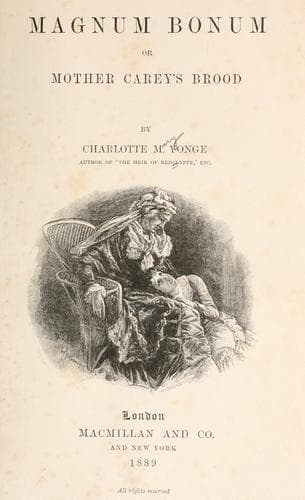
Magnum Bonum; Or, Mother Carey's BroodYonge, Charlotte M. (Charlotte Mary)
General
Magnum Bonum; Or, Mother Carey's Brood
Yonge, Charlotte M. (Charlotte Mary)
Domestic fiction; England -- Social life and customs -- 19th century -- Fiction; Religious fiction
Jock and Cecil greatly rejoiced, for the departing Captain had been a
youth whose incapacity for government had been much better known to his
subordinates than to his master, and the other two had been the special
tempters and evil geniuses of the house, those who above all had set
themselves to make obedience and religion seem contemptible, and vice
daring and manly.
“I should have hated the notion of being Captain,” wrote John, “if those
impracticable fellows had stayed on, and if I did not feel sure of you
and Evelyn. You are such a fellow for getting hold of the others, but
with you two at my back, I really think the house may get a different
tone into it.”
“And every one told us what an excellent character it had,” said Mrs.
Evelyn, when the letter, through a chain of strict confidence, came
round to her, the boys little knowing how much it did to decide their
continuance together, and at Eton. Sir James had never been willing that
Cecil should be taken away, and he had become as sensible as any of the
rest to the Brownlow charm.
That was a very happy time in the pine-woods and the Alp. The whole
of the nineteen copy books were actually read by Babie to Sydney and
Armine; and Lord Fordham, over his sketches, submitted to hear a good
deal. He told his mother that the story was the most diverting thing
he had ever heard, with its queer mixture of childish simplicity and
borrowed romance, of natural poetry and of infantine absurdity, of
extraordinary knowledge and equally comical ignorance, of originality
and imitation, so that his great difficulty had been not to laugh in the
wrong place, when Babie had tears in her eyes at the heights of pathos
and sublimity, and Sydney was shedding them for company. It was funny to
come to places where Armine’s slightly superior age and knowledge of the
world began to tell, and when he corrected and criticised, or laughed,
with appeals to his elder friend. Babie was so perfectly good-humoured
about the sacrifice of her pet passages, and even of her dozen
copybooks, that the editor of the “Traveller’s Joy” could not help
encouraging the admission of “Jotapata” into the magazine, in spite of
the remonstrances of the rest of his public, who declared it was
merely making the numbers a great deal heavier for postage, and all for
nothing.
The magazine was well named, for it was a great resource. There were
illustrations of all kinds, from Lord Fordham’s careful watercolours,
and Mrs. Brownlow’s graceful figures or etchings, to the doctor’s clever
caricatures and grotesque outlines, and the contributions were equally
miscellaneous. There were descriptions of scenery, fragmentary notes
of history and science, records more or less veracious or absurd of
personal adventures, and conversations, and advertisements, such as--
Public-domain text, read in full here on John Shaqi.
Reviews
Reviews
No reviews yet
Be the first to share your thoughts on this work.
Elsewhere in the archive
Join the Discussion
Join the discussion
Sign in to leave a comment or review.
Sign InorCreate an account