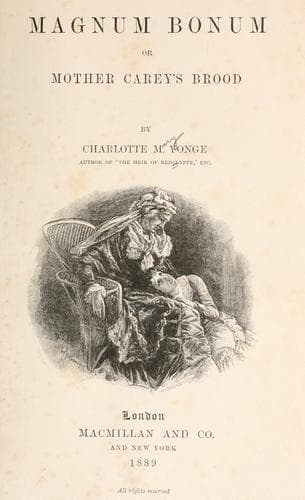
Magnum Bonum; Or, Mother Carey's BroodYonge, Charlotte M. (Charlotte Mary)
General
Magnum Bonum; Or, Mother Carey's Brood
Yonge, Charlotte M. (Charlotte Mary)
Domestic fiction; England -- Social life and customs -- 19th century -- Fiction; Religious fiction
So in the drawing-room the Colonel, with the two wills in his hand,
found himself face to face with her. He was the more nervous of the two,
being, much afraid of upsetting that composure which scandalised his
wife, but which he preferred to tears; and as he believed her to be a
mere child in perception, he explained down to her supposed level,
while she listened in a strange inert way, feeling it hard to fix her
attention, yet half-amused by the simplicity of his elucidations. “Would
Ellen need to be told what an executor meant?” thought she.
She was left sole guardian of the children, “the greatest proof of
confidence a parent can give,” impressively observed the Colonel,
wondering at the languor of her acquiescence, and not detecting the
thought, “Dear Joe! of course! as if he would have done anything else!”
“Of course,” continued the Colonel, “he never expected that it would
have proved more than a nominal matter, a mere precaution. For my own
part, I can only say that I shall be always ready to assist you with
advice or authority if ever you should find the charge too onerous for
you.”
“Thank you,” was all she could bring herself to say at that moment,
feeling that her boys were her own, though the next she was recollecting
that this was no doubt the reason Joe had bidden her live at
Kenminster, and in a pang of self-reproach, was hardly attending to the
technicalities of the matters of property which were being explained to
her.
Her husband had not been able to save much, but his life insurance was
for a considerable sum, and there was also the amount inherited from his
parents. A portion of the means which his mother had enjoyed passed to
the elder brother, and Mrs. Brownlow had sunk most of her individual
property in the purchase of the house in which they lived. By the terms
of Joseph’s will, everything was left to Caroline unreservedly, save
for a stipulation that all, on her death, should be divided among the
children, as she should appoint. The house was not even secured to
Allen, so that she could let or sell it as she thought advisable.
“I could not sell it,” said Carey quickly, feeling it her first and only
home. “I hope to see Allen practising there some day.”
“It is not in a situation where you could sell it to so much advantage
as you would have by letting it to whoever takes the practice.”
She winced, but it was needful to listen, as he told her of the offers
that had been made for the house and the good-will of the practice.
What he had thought the best offer was, however, rejected by her with
vehemence. She was sure that Joe would never stand that man coming in
upon his patients, and when asked for her reasons, would only reply,
that “None of us could bear him.”
“That is no reason why he should not be a good practitioner and
respectable man. He may not be what you like in society, and yet--”
“Ask Dr. Lucas,” hastily interrupted Carey.
Public-domain text, read in full here on John Shaqi.
Reviews
Reviews
No reviews yet
Be the first to share your thoughts on this work.
Join the Discussion
Join the discussion
Sign in to leave a comment or review.
Sign InorCreate an account