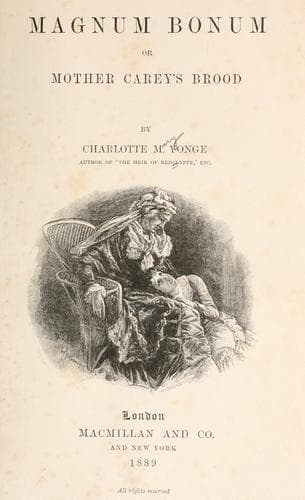
Magnum Bonum; Or, Mother Carey's BroodYonge, Charlotte M. (Charlotte Mary)
General
Magnum Bonum; Or, Mother Carey's Brood
Yonge, Charlotte M. (Charlotte Mary)
Domestic fiction; England -- Social life and customs -- 19th century -- Fiction; Religious fiction
After the morning’s examination and placing of the boys, there was a
half-holiday; and the brother and sister set forth to enjoy it together,
for Kenminster was a place with special facilities for enjoyment. It was
built as it were within a crescent, formed by low hills sloping down to
the river; the Church, school, and other remnants of the old collegiate
buildings lying in the flat at the bottom, and the rest of the town, one
of the small decayed wool staples of Somerset, being in terraces on
the hill-side, with steep streets dividing the rows. These were of very
mixed quality and architecture, but, as a general rule, improved the
higher they rose, and were all interspersed with gardens running up or
down, and with a fair sprinkling of trees, whose budding green looked
well amid the yellow stone.
On the summit were some more ornamental villa-like houses, and grey
stone buildings with dark tiled roofs, but the expansion on that side
had been checked by extensive private grounds. There were very beautiful
woods coming almost close to the town, and in the absence of the owner,
a great moneyed man, they were open to all those who did not make
themselves obnoxious to the keepers; and these, under an absentee
proprietor, gave a free interpretation to rights of way. Thither were
the Ogilvies bound, in search of primrose banks, but their way led
them past two or three houses on the hill-top, one of which, being
constructed on supposed Chinese principles of architecture, was known
to its friends as “the Pagoda,” to its foes as “the Folly.” It had been
long untenanted, but this winter it had been put into complete repair,
and two rooms, showing a sublime indifference to consistency of
architecture, had been lately built out with sash windows and a slated
roof, contrasting oddly with the frilled and fluted tiles of the tower
from which it jutted.
Suddenly there sounded close to their ears the words--“School time, my
dear!”
Starting and looking round for some impertinent street boy, Mr. Ogilvie
exclaimed, “What’s that?”
“Mother Carey! We are all Mother Carey’s chickens.”
“See, there,” exclaimed Mary, and a great parrot was visible on the
branch of a sumach, which stretched over the railings of the low wall of
the pagoda garden. “O you appropriate bird,--you surely ought not to be
here!”
To which the parrot replied, “Hic, haec, hoc!” and burst out in a wild
scream of laughing, spreading her grey wings, and showing intentions of
flying away; but Mr. Ogilvie caught hold of the chain that hung from her
leg.
Just then voices broke out--
“That’s Polly! Where is she? That’s you, Jock, you horrid boy.”
“Well, I didn’t see why she shouldn’t enjoy herself.”
“Now you’ve been and lost her. Poll, Poll!”
“I have her!” called back Mr. Ogilvie. “I’ll bring her to the gate.”
Thanks came through the hedge, and the brother and sister walked on.
Public-domain text, read in full here on John Shaqi.
Reviews
Reviews
No reviews yet
Be the first to share your thoughts on this work.
Join the Discussion
Join the discussion
Sign in to leave a comment or review.
Sign InorCreate an account