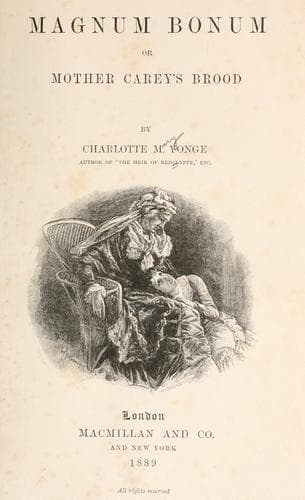
Magnum Bonum; Or, Mother Carey's BroodYonge, Charlotte M. (Charlotte Mary)
General
Magnum Bonum; Or, Mother Carey's Brood
Yonge, Charlotte M. (Charlotte Mary)
Domestic fiction; England -- Social life and customs -- 19th century -- Fiction; Religious fiction
“Never before.” That was the burthen of the song of the little bird with
wounded wing who had been received into this nest. She had the dimmest
remembrance of home or mother, something a little clearer of her sojourn
at her aunt’s, though there the aunt had been an invalid who kept her in
restraint in her presence, and her pleasures had been in the kitchen and
in a few books, probably ‘Don Quixote’ and ‘Evelina,’ so far as could
be gathered from her recollection of them. The week her father had spent
with her, before his last voyage, had been the one vivid memory of her
life, and had taught her at least how to love. Poor child, that happy
week had had to serve her ever since, through eleven years of unbroken
school! Not that she pitied herself. Everybody had been kind to
her--governesses, masters, girls, and all. She had been happy and
successful, and had made numerous friends, about whom, as she grew more
at home, she freely chatted to Mrs. Brownlow, who was always ready to
hear of Mary Ogilvie and Clara Cartwright, and liked to draw out the
stories of the girl-world, in which it was plain that Caroline Allen had
been a bright, good, clever girl, getting on well, trusted and liked.
She had been half sorry to leave her dear old school, half glad to go
on to something new. She was evidently not so comfortable, while Miss
Heath’s lowest teacher, as she had been while she was the asylum’s
senior pupil. Yet when on Sunday evening the Doctor was summoned and the
ladies were left tete-a-tete, she laughed rather than complained. But
still she owned, with her black head on Mrs. Brownlow’s lap, that she
had always craved for something--something, and she had found it now!
Everything was a fresh joy to her, every print on the walls, every
ornament on the brackets, seemed to speak to her eye and to her soul
both at once, and the sense of comfort and beauty and home, after the
bareness of school, seemed to charm her above all. “I always did want to
know what was inside people’s windows,” she said.
And in the same way it was a feast to her to get hold of “a real book,”
as she called it, not only the beginnings of everything, and selections
that always broke off just as she began to care about them. She had been
thoroughly well grounded, and had a thirst for knowledge too real to
have been stifled by the routine she had gone through--though, said she,
“I do want time to get on further, and to learn what won’t be of any
use!”
“Of no use!” said Mr. Brownlow laughing--having just found her trying to
make out the Old English of King Alfred’s ‘Boethius’--“such as this?”
“Just so! They always are turning me off with ‘This won’t be of any use
to you.’ I hate use--”
“Like Ridley, who says he reads a book with double pleasure if he is not
going to review it.”
“That Mr. Ridley who came in last evening?”
“Even so. Why that opening of eyes?”
“I thought a critic was a most formidable person.”
Public-domain text, read in full here on John Shaqi.
Reviews
Reviews
No reviews yet
Be the first to share your thoughts on this work.
Join the Discussion
Join the discussion
Sign in to leave a comment or review.
Sign InorCreate an account