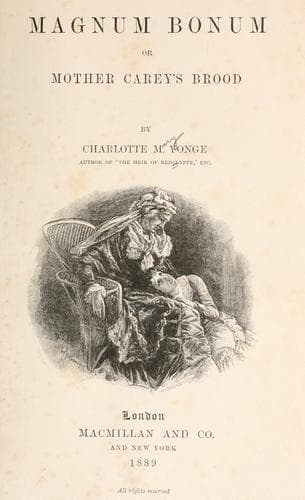
Magnum Bonum; Or, Mother Carey's BroodYonge, Charlotte M. (Charlotte Mary)
General
Magnum Bonum; Or, Mother Carey's Brood
Yonge, Charlotte M. (Charlotte Mary)
Domestic fiction; England -- Social life and customs -- 19th century -- Fiction; Religious fiction
“I thought the children would have been with their cousins,” observed
the aunt.
“So we were,” returned Armine; “but Johnnie and Joe ran away when they
saw Mr. Ogilvie coming.”
Babie having by this time had a little black hat tied on, and as
much arrowroot as possible brushed out of her frock; Carey warned the
schoolmaster not to let himself be chattered to death, and he walked off
with the three younger ones.
Caroline would have kept her friend, but Mary, seeing that little good
could be gained by staying with her at present, replied that she would
take the walk now, and return to her friend in a couple of hours’ time;
and Carey was fain to consent, though with a very wistful look in her
eyes.
At the end of that time, or more, Janet met the party at the garden
gate. “You are to go down to my uncle’s, children,” she said; “mother
has one of her very bad headaches.”
There was an outcry that they must take her the flowers, of which their
hands and arms were full; but Janet was resolute, though Babie was very
near tears.
“To-morrow--to-morrow,” she said. “She must lie still now, or she won’t
be able to do anything. Run away, Babie, they’ll be waiting tea for you.
Allen’s there. He’ll take care of you.”
“I want to give Mother Carey those dear white flowers,” still entreated
Babie.
“I’ll give them, my dear. They want you down there--Ellie and Esther.”
“I don’t want to play with Ellie and Essie,” sturdily declared Barbara.
“They say it is telling falsehoods when one wants to play at anything.”
“They don’t understand pretending,” said Armine. “Do let us stay, Janet,
we’ll not make one smallest little atom of noise, if Jock doesn’t stay.”
“You can’t,” said Janet, “for there’s nothing for you to eat, and nurse
and Susan are as savage as Carribee islanders.”
This last argument was convincing. The children threw their flowers into
Janet’s arms, gave their hands to Miss Ogilvie, and Babie between her
two brothers, scampered off, while Miss Ogilvie uttered her griefs and
regrets.
“My mother would like to see you,” said Janet; “indeed, I think it will
do her good. She told me to bring you in.”
“Such a day of fatigue,” began Mary.
“That and all the rest of it,” said Janet moodily.
“Is she subject to headaches?”
“No, she never had one, till--” Janet broke off, for they had reached
her mother’s door.
“Bring her in,” said a weary voice, and Mary found herself beside a low
iron bed, where Carey, shaking off the handkerchief steeped in vinegar
and water on her brow, and showing a tear-stained, swollen-eyed face,
threw herself into her friend’s arms.
But she did not cry now, her tears all came when she was alone, and when
Mary said something of being so sorry for her headache, she said, “Oh!
it’s only with knocking one’s head against a mattress like mad people,”
in such a matter-of-fact voice, that Mary for a moment wondered whether
she had really knocked her head.
Public-domain text, read in full here on John Shaqi.
Reviews
Reviews
No reviews yet
Be the first to share your thoughts on this work.
Join the Discussion
Join the discussion
Sign in to leave a comment or review.
Sign InorCreate an account