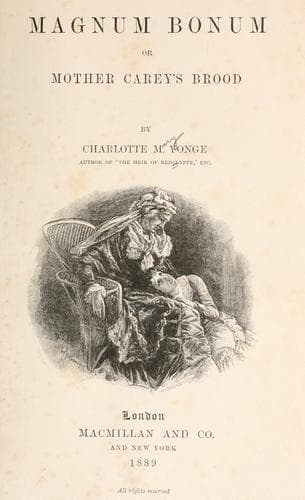
Magnum Bonum; Or, Mother Carey's BroodYonge, Charlotte M. (Charlotte Mary)
General
Magnum Bonum; Or, Mother Carey's Brood
Yonge, Charlotte M. (Charlotte Mary)
Domestic fiction; England -- Social life and customs -- 19th century -- Fiction; Religious fiction
They all walked home together, talking merrily, and Mr. and Miss Ogilvie
came in with them, on special entreaty, to share the supper--milk,
fruit, bread and butter and cheese, and sandwiches, which was laid out
on the round table in the octagon vestibule, which formed the lowest
story of the tower. It was partaken of standing, or sitting at case on
the window-seats, a form or two, an old carved chair, or on the stairs,
the children ascending them after their meal, and after securing in
their own fashion their treasures for the morrow. The two cousins had
already bidden good-night at the gate and gone home, and the Ogilvies
followed their example in ten minutes, Caroline begging Mary to come up
to her as soon as Mr. Ogilvie was disposed of by school hours.
“But you will be busy?” said Mary.
“Never mind, I am afraid we are not very regular,” said Carey.
It was by this time ten o’clock, and the two younger children were still
to be heard shouting to one another up stairs about the leaves for their
chrysalids. So when Mary came up the hill at half-past ten the next
morning, she was the less surprised to find these two only just
beginning breakfast, while their mother was sitting at the end of the
table knitting, and hearing Janet repeat German poetry. The boys had
long been in school.
Caroline jumped up and threw her arms round Mary’s neck, declaring that
now they would enjoy themselves. “We are very late,” she added, “but
these late walks make the little people sleep, and I think it is better
for them than tossing about, hot and cross.”
Mary was rather entertained at this new code, but said nothing, as Carey
pointed out to the children how they were to occupy themselves under
Janet’s charge, and the work they had to do showed that for their age
they had lost no time.
The drawing-room showed indeed a contrast to the chaotic state in which
it had been left. It was wonderfully pleasant-looking. The windows of
the deep bay were all open to the lawn, shaded with blinds projecting
out into the garden, where the parrot sat perched on her pole; pleasant
nooks were arranged in the two sides of the bay window, with light
chairs and small writing-tables, each with its glass of flowers; the
piano stood across the arc, shutting off these windows into almost a
separate room; low book-cases, with chiffonier cupboards and marble
tops, ran round the walls, surmounted with many artistic ornaments.
The central table was crowned with a tall glass of exquisitely-arranged
grasses and wild flowers, and the choice and graceful nicknacks round it
were such as might be traced to a London life in the artist world, and
among grateful patients.
Public-domain text, read in full here on John Shaqi.
Reviews
Reviews
No reviews yet
Be the first to share your thoughts on this work.
Elsewhere in the archive
Join the Discussion
Join the discussion
Sign in to leave a comment or review.
Sign InorCreate an account