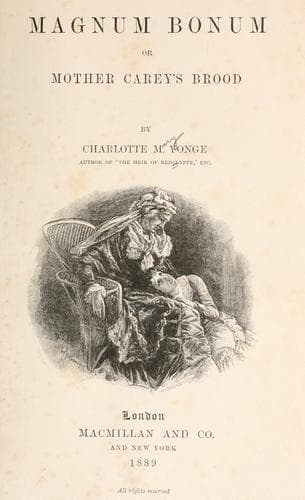
Magnum Bonum; Or, Mother Carey's BroodYonge, Charlotte M. (Charlotte Mary)
General
Magnum Bonum; Or, Mother Carey's Brood
Yonge, Charlotte M. (Charlotte Mary)
Domestic fiction; England -- Social life and customs -- 19th century -- Fiction; Religious fiction
Brackets with vases and casts here and there projected from the walls,
and some charming crayons and water-colours hung round them. The
plastered walls had already been marked out in panels, and a growth of
frescoes of bulrushes, ivy, and leaves of all kinds was beginning to
overspread them, while on a nearer inspection the leaves proved to be
fast becoming peopled with living portraits of butterflies and other
insects; indeed Mary started at finding herself in, as she thought,
unpleasant proximity to a pair of cockchafers.
“Ah! I tell the children that we shall be suspected of putting those
creatures there as a trial to the old ladies’ nerves,” said Caroline,
laughing.
“I confess they are startling to those who don’t like creeping things!
Have you many old ladies, Carey?”
“Not very many. I fancy they don’t take to me more than I take to them,
so we are mutually satisfied.”
“But is that a good thing?” said Mary anxiously.
“I don’t know,” said Carey, indifferently. “At least I do know,” she
added, “that I always used to be told I didn’t try to make small talk,
and I can do it less than ever now that it is the smallest of small, and
my heart faints from it. Oh Mary!”
“My poor dear Caroline! But you say that you were told you ought to do
it?”
“Well, yes. Dear granny wished it; but I think that was rather with a
view to Joe’s popularity, and we haven’t any patients to think of now. I
should think the less arrant gossip the children heard, the better.”
“But is it well to let them despise everybody?”
“Then the less they see of them, the better!”
“For shame, Carey!”
“Well, Mary, I dare say I am naughty. I do feel naughtier now than
ever I did in my life; but I can’t help it! It just makes me mad to
be worried or tied down,” and she pushed back her hair so that her
unfortunate cap was only withheld from tumbling entirely off by the pin
that held it.
“Oh, that wretched cap!” she cried, jumping up, petulantly, and going
to the glass to set it to rights, but with so hasty a hand that the pin
became entangled in her hair, and it needed Mary’s quiet hand to set it
to rights; “it’s just an emblem of all the rest of it; I wouldn’t
wear it another day, but that I’m afraid of Ellen and Robert, and it
perfectly drives me wild. And I know Joe couldn’t have borne to see me
in it.” At the Irishism of which she burst out laughing, and laughed
herself into the tears that had never come when they were expected of
her.
Mary caressed and soothed her, and told her she could well guess it was
sadder to her now than even at first.
“Well, it is,” said Carey, looking up. “If one was sent out to sea in a
boat, it wouldn’t be near so bad as long as one could see the dear
old shore still, as when one had got out--out into the wide open--with
nothing at all.”
And she stretched out her hands with a dreary, yearning gesture into the
vacant space, such as it went to her friend’s heart to see.
“Ah! but there’s a haven at the end.”
Public-domain text, read in full here on John Shaqi.
Reviews
Reviews
No reviews yet
Be the first to share your thoughts on this work.
Elsewhere in the archive
Join the Discussion
Join the discussion
Sign in to leave a comment or review.
Sign InorCreate an account