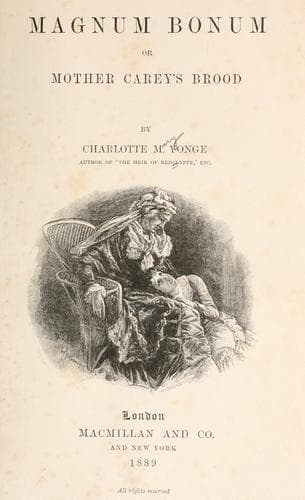
Magnum Bonum; Or, Mother Carey's BroodYonge, Charlotte M. (Charlotte Mary)
General
Magnum Bonum; Or, Mother Carey's Brood
Yonge, Charlotte M. (Charlotte Mary)
Domestic fiction; England -- Social life and customs -- 19th century -- Fiction; Religious fiction
“So that’s what we get,” said Mary, to herself, half amused, half
annoyed; “those men think it is all because one is left behind in the
dark! David is the best boy in the world, but there’s not a man of them
all who has a notion of what gets a woman into trouble! I believe he was
rather gratified than otherwise to be found out on a lark. Well, I’ll
talk to Clara; she will have some sense!”
They were all to meet at the station the next morning, to go to an old
castle, about an hour from Kenminster by railway; and they filled the
platform, armed with sketching tools, sandwich baskets, botanical tins,
and all other appliances; but when Mr. Ogilvie accosted Mrs. Joseph
Brownlow, saying, “You have only half your boys,” she looked up, with
a drolly guilty air, saying, “No, there’s an embargo on the other poor
fellows.”
They had just taken their seats, and the train was in motion, when a
heated headlong boy came dashing over the platform, and clung to the
door of the carriage, standing on the step. It was Johnny. Orlando
Hughes, who was next the window, grasped his hands, and, in answer to
the cries of dismay and blame that greeted him, he called out, “Yes,
here I am; Rob and Joe couldn’t run so fast.”
“Then you’ve got leave?” asked his aunt.
Johnny’s grin said “No.”
She looked up at Mr. Ogilvie in much vexation and anxiety.
“Don’t say any more to him now. It might put him in great danger. Wait
till the next station,” he said.
It was a stopping train, and ten minutes brought a halt, when the guard
came up in a fury, and Johnny found no sympathy for his bold attempt.
Carey had no notion of fostering flat disobedience, and she told Johnny
that unless he would promise to go home by himself and beg his father’s
pardon, she should stay behind and go back with him, for she could
have no pleasure in an expedition with him when he was behaving so
outrageously.
The boy looked both surprised and abashed. His affection for his aunt
was very great, as for one who had opened to him the gates of a new
world, both within himself and beyond himself. He would not hear of her
giving up the expedition, and promised her with all his heart to walk
home, and confess, “Though ‘twasn’t papa, but mamma!” were his last
words, as they left him on the platform, crestfallen, but with a twinkle
in his eye, and with the station-master keeping watch over him as a
dangerous subject.
Mr. Ogilvie said it would do the boy good for life; Caroline mourned
over him a little, and wondered how his mother would treat him; and Mary
sat and thought till the arrival at their destination, when they had
to walk to the castle, dragging their appurtenances, and then to rouse
their energies to spread out the luncheon.
Public-domain text, read in full here on John Shaqi.
Reviews
Reviews
No reviews yet
Be the first to share your thoughts on this work.
Elsewhere in the archive
Join the Discussion
Join the discussion
Sign in to leave a comment or review.
Sign InorCreate an account