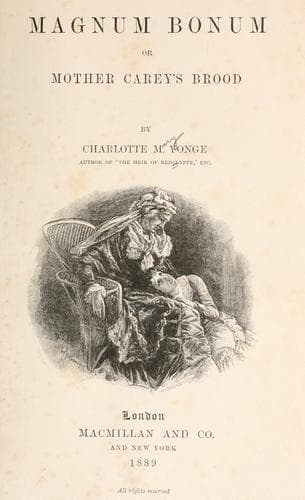
Magnum Bonum; Or, Mother Carey's BroodYonge, Charlotte M. (Charlotte Mary)
General
Magnum Bonum; Or, Mother Carey's Brood
Yonge, Charlotte M. (Charlotte Mary)
Domestic fiction; England -- Social life and customs -- 19th century -- Fiction; Religious fiction
Then, when there had been the usual amount of mirth, mischief, and
mishap, and the party had dispersed, some to sketch, some to scramble,
some to botanize, the “Duck and Drake to spoon,”--as said the boys, Mary
Ogilvie found a turfy nook where she could hold council with Mrs. Acton
about their poor little friend, for whose welfare she was seriously
uneasy.
But Clara did not sympathise as much as she expected, having been much
galled by Mrs. Robert Brownlow’s supercilious manner, and thinking the
attempt to conciliate her both unworthy and useless.
“Of course I do not mean that poor Carey should truckle to her,” said
Mary, rather nettled at the implication; “but I don’t think these
irregular hours, and all this roaming about the country at all times,
can be well in themselves for her or the children.”
“My dear Mary, did you never take a party of children into the country
in the spring for the first time? If not, you never saw the prettiest
and most innocent of intoxications. I had once to take the little
Pyrtons to their place in the country one April and May, months that
they had always spent in London; and I assure you they were perfectly
mad, only with the air, the sight of the hawthorns, and all the smells.
I was obliged to be content with what they could do, not what ought to
be done, of lessons. There was no sitting still on a fine morning. I was
as bad myself; the blood seemed to dance in one’s veins, and a room to
be a prison.”
“This is not spring,” said Mary.
“No, but she began in spring, and habits were formed.”
“No doubt, but they cannot be good. They keep up flightiness and
excitability.”
“Oh, that’s grief, poor dear!”
“We bain’t carousing, we be dissembling grief, as the farmer told the
clergyman who objected to merry-making after a funeral,” said Mary,
rather severely. Then she added, seeing Clara looked annoyed, “You think
me hard on poor dear Carey, but indeed I am not doubting her affection
or her grief.”
“Remember, a woman with children cannot give herself entirely up to
sorrow without doing them harm.”
“Poor Carey, I am sure I do not want to see her given up to sorrow, only
to have her a little more moderate, and perhaps select--so as not to do
herself harm with her relations--who after all must be more important to
her than any outsiders.”
The artist’s wife could not but see things a little differently from the
schoolmaster’s sister, who moreover knew nothing of Carey’s former life;
and Clara made answer--
“Sending her down to these people was the greatest error of dear good
Dr. Brownlow’s life.”
“I am not sure of that. Blood is thicker than water.”
“But between sisters-in-law it is apt to be only ill-blood, and very
turbid.”
“For shame, Clara.”
Public-domain text, read in full here on John Shaqi.
Reviews
Reviews
No reviews yet
Be the first to share your thoughts on this work.
Elsewhere in the archive
Join the Discussion
Join the discussion
Sign in to leave a comment or review.
Sign InorCreate an account