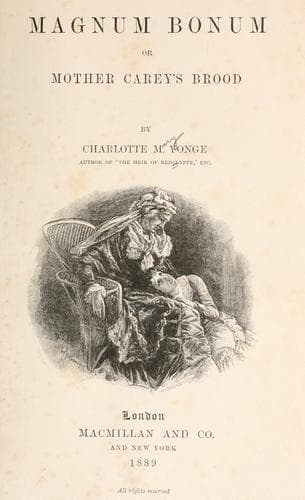
Magnum Bonum; Or, Mother Carey's BroodYonge, Charlotte M. (Charlotte Mary)
General
Magnum Bonum; Or, Mother Carey's Brood
Yonge, Charlotte M. (Charlotte Mary)
Domestic fiction; England -- Social life and customs -- 19th century -- Fiction; Religious fiction
Miss Heath, as Mrs. Brownlow had guessed, thought an engaged girl as
bad as a barrel of gunpowder, and was quite as much afraid of Miss Allen
putting nonsense into her pupils’ heads as the doctor could be of the
reverse process: so, young teachers not being scarce, Carey’s brief
connection with Miss Heath was brought to an end in a morning call,
whence she returned endowed with thirteen book-markers, five mats, and a
sachet.
Carey had of her own, as it appeared, twenty-five pounds a year, which
had hitherto clothed her, and of which she only knew that it was paid to
her quarterly by a lawyer at Bath, whose address she gave. Mr. Brownlow
followed up the clue, but could not learn much about her belongings. The
twenty-five pounds was the interest of the small sum, which had remained
to poor Captain Allen, when he wound up his affairs, after paying the
debts in which his early and imprudent marriage had involved him. He did
not seem to have had any relations, and of his wife nothing was known
but that she was a Miss Otway, and that he had met her in some colonial
quarters. The old lady, with whom the little girl had been left, was her
mother’s maternal aunt, and had lived on an annuity so small that on her
death there had not been funds sufficient to pay expenses without a sale
of all her effects, so that nothing had been saved for the child, except
a few books with her parents’ names in them--John Allen and Caroline
Otway--which she still kept as her chief treasures. The lawyer, who had
acted as her guardian, would hand over to her five hundred pounds on her
coming of age.
That was all that could be discovered, nor was Colonel Robert Brownlow
as much flattered as had been hoped by the provision for his friend’s
daughter. Nay, he was inclined to disavow the friendship. He was sorry
for poor Allen, he said, but as to making a friend of such a fellow,
pah! No! there was no harm in him, he was a good officer enough, but he
never had a grain of common sense; and whereas he never could keep
out of debt, he must needs go and marry a young girl, just because he
thought her uncle was not kind to her. It was the worst thing he could
have done, for it made her uncle cast her off on the spot, and then
she was killed with harass and poverty. He never held up his head again
after losing her, and just died of fever because he was too broken down
to have energy to live. There was enough in this to weave out a tender
little romance, probably really another aspect of the truth, which made
Caroline’s bright eyes overflow with tears, when she heard it couched in
tenderer language from Joseph, and the few books and treasures that
had been rescued agreed with it--a Bible with her father’s name, a few
devotional books of her mother’s, and Mrs. Hemans’s poems with “To Lina,
from her devoted J. A.”
Caroline would fain have been called Lina, but the name did not fit her,
and would not _take_.
Public-domain text, read in full here on John Shaqi.
Reviews
Reviews
No reviews yet
Be the first to share your thoughts on this work.
Join the Discussion
Join the discussion
Sign in to leave a comment or review.
Sign InorCreate an account