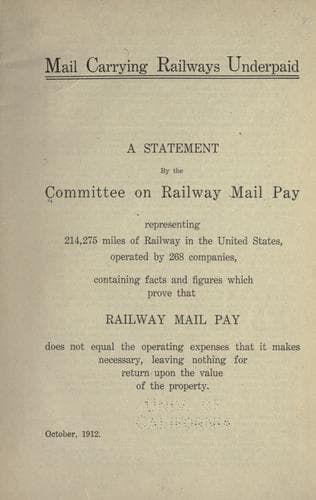
Mail Carrying Railways UnderpaidCommittee on Railway Mail Pay
History
Mail Carrying Railways Underpaid
Committee on Railway Mail Pay
Railway mail service -- United States
The Congressional Joint Commission to Investigate the Postal Service,
which reported on January 14, 1901, is authority for the fact that, at
that time, railway mail pay was not excessive. Senator William B.
Allison, of Iowa; Senator Edward S. Wolcott, of Colorado; Senator
Thomas S. Martin, of Virginia; Representative Eugene F. Loud, of
California; Representative W. H. Moody, of Massachusetts, and
Representative T. C. Catchings, of Mississippi, six of the eight
members of the Commission, then united in the following:
"Upon a careful consideration of all the evidence and the
statements and arguments submitted, and in view of all the
services rendered by the railways, we are of the opinion
that 'the prices now paid to the railroad companies for the
transportation of the mails' are not excessive, and
recommend that no reduction thereof be made at this time."
Fifty-second Congress, Second Session, Senate Document No.
89, pp. 19, 22, 25, 29.
Since the Commission reported, the volume of the American mails, the
revenue of the American postal service and its demands upon the
railways for services and facilities have greatly increased. The costs
of supplying railway transportation have also greatly increased. The
necessary cost of railway property per unit of service has increased,
and in consequence the amount required as a reasonable return thereon,
on account of higher wages and prices, the higher standards of service
demanded and the higher value of the real estate required for extended
and necessary terminal plants. Operating expenses have grown by reason
of repeated advances in rates of wages paid to employees of every
grade and increased prices of materials and supplies. Taxes have
increased with the rapidly augmenting exactions of State and local
governments and the imposition of an entirely new Federal corporation
tax.[G] Yet during this period of rapidly advancing railway expenses,
and in spite of the fact that at its commencement the railway mail pay
was not excessive, the rates of payment for railway mail services have
been subjected to repeated and drastic decreases accomplished both by
legislative action and by administrative orders. These reductions have
so much more than offset the rather doubtful advantages which the
railways might be assumed to have obtained from the increased volume
of mail traffic that in 1912 they find their mail service more
unprofitable than ever before. The following table shows the facts:
Average railway mail
Fiscal Total railway pay per $100.00 of
Year mail pay postal receipts.
1901 $38,158,969 $34.18
1904 43,971,848 30.62
1907 49,758,071 27.10
1910 49,405,311 22.04
1911 50,583,123 21.26
Public-domain text, read in full here on John Shaqi.
Reviews
Reviews
No reviews yet
Be the first to share your thoughts on this work.
Join the Discussion
Join the discussion
Sign in to leave a comment or review.
Sign InorCreate an account