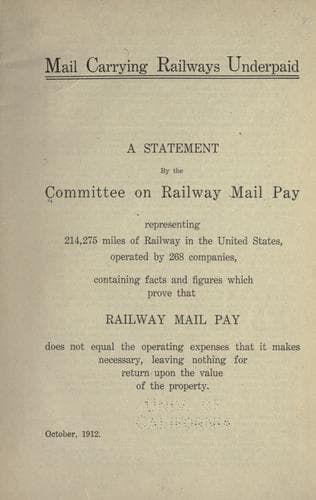
Mail Carrying Railways UnderpaidCommittee on Railway Mail Pay
History
Mail Carrying Railways Underpaid
Committee on Railway Mail Pay
Railway mail service -- United States
The foregoing discussion makes plain the error and injustice in the
Postmaster-General's proposal to pay the railways for carrying the
mail upon the basis of returning to them the operating expenses and
taxes, as ascertained by the Post Office Department, attributable to
the carriage of the mails, plus six per cent. of the sum of these
expenses and taxes.
The discussion under heading III above demonstrates that the plan
leaves out of consideration any allowance for return upon the property
and would be destructive of the universally recognized rights of the
railroad companies.
Furthermore, such a plan is fundamentally erroneous because it
involves paying the highest rates to the railroad that by reason of
physical disabilities or inefficient methods is most expensively
operated and the lowest rates to the railroad which, by reason of the
highest efficiency, operates at the lowest cost. A railroad's superior
operating efficiency is frequently due to exceptionally heavy capital
expenditures to obtain low grades, two, three or four main tracks, and
to improve in other respects the roadbed and tracks to the end that
trains may be hauled at the lowest expense. Such a railroad needs, and
is entitled to sufficient net earnings to enable it to pay a proper
return upon the increased value which is due to such expenditures. But
under the Postmaster-General's plan, a railroad would be penalized for
all the capital expenditures made by it for the purpose of decreasing
its operating cost, because the more it decreased its operating cost
the more it would decrease its mail pay.
The ascertainment of the cost to a railroad of conducting mail service
is necessarily very largely a matter of judgment and opinion, because
a large proportion of the total operating expenses are common to the
freight and passenger traffic and can only be approximately
apportioned. There is room for a very wide discretion in the making of
such apportionments. It would not be right or proper to entrust the
Post Office Department with the discretion of making such
apportionment, because the Post Office Department has an obvious
interest at stake, its object always being to reduce the railroad pay
to a minimum.
Public-domain text, read in full here on John Shaqi.
Reviews
Reviews
No reviews yet
Be the first to share your thoughts on this work.
Join the Discussion
Join the discussion
Sign in to leave a comment or review.
Sign InorCreate an account