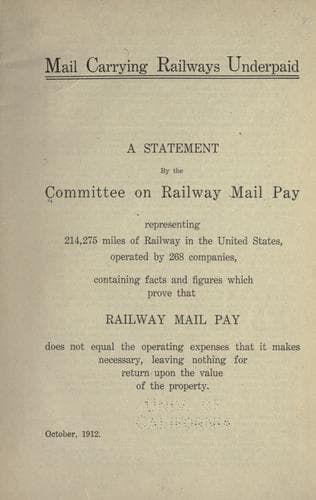
Mail Carrying Railways UnderpaidCommittee on Railway Mail Pay
History
Mail Carrying Railways Underpaid
Committee on Railway Mail Pay
Railway mail service -- United States
[Footnote A: The necessity for providing, out of income, for
some kinds of improvements is commonly admitted. The public
constantly demands greater comfort and convenience which can
be supplied only by improvements in property and equipment
that bring in no additional income. A present example in the
mail service, itself, is the great expense which the railways
are now undergoing in substituting steel mail cars for those
formerly in use. The old cars, which thus become a total loss
were fully up to the most advanced standards of construction
when built and they could continue for a long time to serve
the purposes of the service except for the public demand for
stronger cars.]
Plainly, the Postmaster-General's proposal is equivalent to an
assertion that the railways would make a fair profit if they were
enabled to collect the sum of $115,585,568 in addition to their
operating expenses and taxes, but the figures given by the Interstate
Commerce Commission show that this would be less than one-third of
the sum necessary to meet interest charges which must be paid in order
to prevent foreclosures of mortgages and, if bond interest could be
ignored, is much less than the rentals that must be paid if the
existing systems are not to be broken up. And, of course, it would
allow nothing whatever for legitimate demands upon income for
dividends, permanent improvements or surplus.
It is unnecessary to dwell upon the consequences of such a theory of
"compensation" to railroad credit and to the public interest in
efficient transportation service, to say nothing of the consequences
to owners of railroad stock and bonds. Such a theory is not a theory
of compensation--it is a theory of oppression and of destruction.
The fact that the Postmaster-General has found it necessary to justify
his attack upon the present basis of railway mail pay by a theory so
unprecedented and so unwarranted in principle and in law, raises a
strong presumption against all his opinions and conclusions upon this
subject.
IV. THE MAIL SERVICE SUPPLIED BY THE RAILWAYS COSTS THEM MORE IN
OPERATING EXPENSES AND TAXES THAN THEY ARE PAID FOR IT, AND LEAVES
NOTHING FOR RETURN ON THE PROPERTY.
It cannot be too strongly emphasized that the railway mail pay at
present is insufficient to pay even its proper share of operating cost
and taxes and does not produce any return upon the property. This will
be demonstrated by any fair inquiry, as will now be shown. Reports
submitted to the Postmaster-General by railways operating 2,411 mail
routes, with a total length of 178,710 miles, showed that their gross
receipts, per car-foot mile[B], from services rendered on passenger
trains during November, 1909, were as follows:
From mail 3.23 mills
From other services 4.35 mills
Public-domain text, read in full here on John Shaqi.
Reviews
Reviews
No reviews yet
Be the first to share your thoughts on this work.
Join the Discussion
Join the discussion
Sign in to leave a comment or review.
Sign InorCreate an account