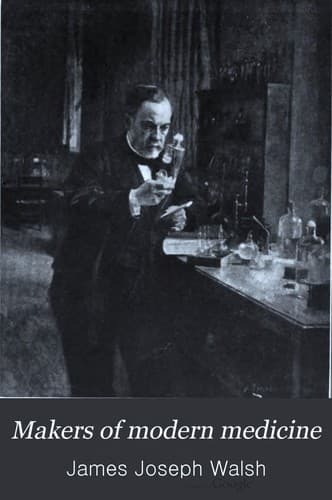
Makers of Modern MedicineWalsh, James J. (James Joseph)
History
Makers of Modern Medicine
Walsh, James J. (James Joseph)
Medicine -- Biography
"The chief objection to our present mode of teaching is that,
however well inclined the student may be, he is never obliged to
exercise his own judgment in distinguishing diseases and has no
opportunity of trying his skill in their cure, and consequently at
the end of his studies he is perhaps well grounded in the accessory
sciences--is a perfect medical logician--able to arrange the names
of diseases in their classes, orders and different subdivisions; he
may be master of the most difficult theories of modern
physiologists; he may have heard, seen and, if a member of the
medical society, he may also have talked a great deal; but at the
end of all this preparation what is he when he becomes a full
doctor?--a practitioner who has never practised!"
These words have quite as suggestive applications to most phases of
our modern education as they had to that of Graves' time. There are
other passages that bear so significant a meaning in this regard that
one can scarcely refrain from quoting:
"Our present method of instruction is indeed very useful and nothing
better can be devised for a beginner; but for {183} the more
advanced student it is by no means sufficient, nor is it calculated
to give him practical experience, without which all other
acquirements are of no avail. I say it does not give him experience,
because he has at no time been charged with the responsibility of
investigating a case for himself, and by himself; because at no time
has he been called on to make a diagnosis, unassisted by others; and
above all because he has never been obliged to act upon that diagnosis
and prescribe the method of treatment. If those who had been thus
educated, and who had been made doctors upon so slender a
foundation, were to confess the truth, we should be presented with a
picture calculated to excite dismay if not a stronger feeling. How
many doubts and distracting anxieties attend such a man at his first
patient's bedside. If the disease be acute and life in imminent
danger, and if he shrink under this sudden and unusual load of
responsibility, he gains little credit for professional ability. If,
on the contrary, inexperienced as he is, he assumes that decision of
judgment, that energy of practice which experience alone can confer,
is it not probable that the result will be still more disastrous?"
Graves' last days and the circumstances of his death and burial are
given by Professor Stokes, his great personal friend, and himself one
of the most distinguished physicians of his time. We quote the
concluding paragraph of Professor Stokes' biographical notice:
Public-domain text, read in full here on John Shaqi.
Reviews
Reviews
No reviews yet
Be the first to share your thoughts on this work.
Elsewhere in the archive
Join the Discussion
Join the discussion
Sign in to leave a comment or review.
Sign InorCreate an account