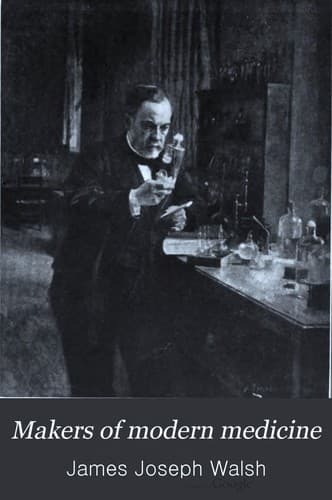
Makers of Modern MedicineWalsh, James J. (James Joseph)
History
Makers of Modern Medicine
Walsh, James J. (James Joseph)
Medicine -- Biography
"It was in the autumn of 1852, he being then in his fifty-seventh
year, that the symptoms of the malady which was to prove fatal first
showed themselves. In the following February he began to succumb to
the disease. Although at times his sufferings were great, yet he had
many intervals of freedom from pain. And he then showed all his old
cheerfulness and energy. To the very last he continued to {184} take
pleasure in hearing of any advance of knowledge that tended to
ameliorate the condition of man, or to throw light on his relations
to a future state. In this latter point of view, the discoveries of
Layard greatly interested him, as illustrative of the Sacred
History; and thus he was permitted to fill up the intervals of his
sufferings, even to the last; for his mental faculties never failed
or flagged,--a mercy for which he often expressed a fervent
gratitude; and so he was providentially enabled to review the past,
and to form a calm and deliberate judgment on the religious
convictions of his earlier years. And once the truthfulness of these
were ascertained, he adhered to them with that earnestness which
characterized all his decisions.
"It was after the attainment of this state of patient expectation
that one who was dear to him expressed a prayerful wish for his
recovery. 'Do not ask for that,' he replied; 'it might prove a fatal
trial.'
"His mind having become thus satisfied he made few remarks on these
subjects, except in reply to the inquiries of others. Thus, when
referred to the prophetic illustration of purifying and redeeming
love, 'A fountain shall be opened for sin and for uncleanness,'
'No,' he said, 'not a fountain, but an ocean.'
"On the day before his death he desired (a second time) to partake
of the Holy Communion, with his family. When some explanations were
commenced, he answered, 'I know all that; I do not regard this as a
charm, but I wish to die under the banner of Christ.' Feeling
himself sinking, he asked for prayer, and a petition was offered
suitable to his condition; but he seemed to long for something more
and, when questioned, replied, 'I want some prayer that I know, some
of the prayers of my youth, some of my father's prayers.' The Litany
was commenced, he immediately took up the {185} well-known words,
and when the speaker's voice faltered he continued them alone, and
distinctly, to the end of the strain, 'Whom thou hast redeemed with
thy most precious blood.'
"On the twentieth day of March, 1853, and without renewed suffering,
he ceased to breathe.
"His tomb is in the cemetery of Mount Jerome. It bears the following
inscription dictated by himself:
"ROBERT JAMES GRAVES,
Son of Richard Graves, Prof. of Divinity,
Who,
After a Protracted and Painful Disease,
Died in the Love of God, and
In the
Faith of Jesus Christ."
William Stokes.
Public-domain text, read in full here on John Shaqi.
Reviews
Reviews
No reviews yet
Be the first to share your thoughts on this work.
Elsewhere in the archive
Join the Discussion
Join the discussion
Sign in to leave a comment or review.
Sign InorCreate an account