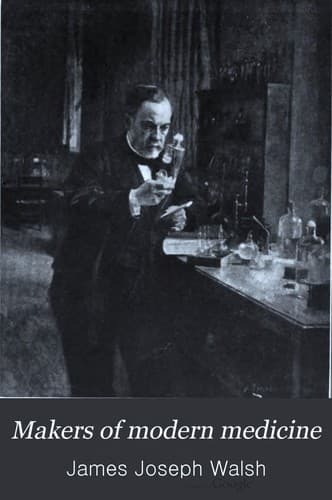
Makers of Modern MedicineWalsh, James J. (James Joseph)
History
Makers of Modern Medicine
Walsh, James J. (James Joseph)
Medicine -- Biography
"There are two qualities in his 'Hand-book of Physiology' which have
particularly enhanced my estimation of its value--its strictly
philosophical method and its completeness {236} in facts. Since the
time of Haller no one has so thoroughly mastered the entire
literature of natural history or collected in all directions so many
original experiences, and no one has been at the same time familiar
with medical practice, as well as with the remotest provinces of
zoology. It has been well said that while Haller often, in doubtful
questions, espoused a side which must eventually be forced to
succumb, Müller always had the luck (if we may call that luck which
was preceded by so much intelligent activity), sooner or later, to
discern the opinion that was sure, eventually, of the victory. He
was wonderfully fitted for the office of critic by his comprehensive
knowledge. He knew how to discriminate the healthy from the unsound,
the essential or real from the adventitious or accidental. And, in
surveying the whole series of forms--often widely different--among
which a well-determined plan of nature seemed to be realized, he
knew the changes which not infrequently altered considerably the
arrangement and composition of the substances within these forms. In
Müller, as a physiologist, it is not the genius of the discoverer,
nor the ground-breaking nature of his observations we admire, but
rather the methodical exactness of investigation in calculating
judgment, the confident tranquility and the perfect consummation of
his knowledge."
In a word, Müller owed the success of his career to the perfect poise
of his intellect and the admirable critical faculty that guided him in
the thorny path of knowledge at a time when there were so few
landmarks of real scientific significance to show the investigator
what the probable course and progress of real science must be. It was
for this reason that, as Virchow has said, the reform of newer views
became embodied in him, and in spite of the almost monastical
retirement of the scholar, the influence of the method introduced by
Müller was not limited to physiology, but continues to {237} spread
beyond that science in ever-widening circles into the domain of all
the biological sciences.
Virchow concludes: "Müller vanquished mysticism and phantasms in the
organic kingdom and he was most distinctly opposed to every dangerous
tendency, whether it was pursued under the pretext of physiology or
belief, or merely in accordance with conjectures. Müller did not
discover, but he firmly established the exact method of investigating
natural sciences: Hence, he did not found a school in the sense of
dogmas--for he taught none, but only in the sense of methods. The
school of natural science which Müller created knew no community of
doctrine, but only of facts and still more of methods."
Public-domain text, read in full here on John Shaqi.
Reviews
Reviews
No reviews yet
Be the first to share your thoughts on this work.
Elsewhere in the archive
Join the Discussion
Join the discussion
Sign in to leave a comment or review.
Sign InorCreate an account