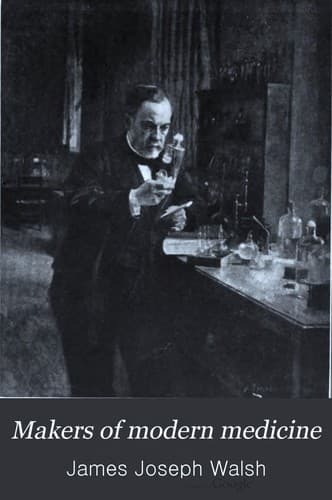
Makers of Modern MedicineWalsh, James J. (James Joseph)
History
Makers of Modern Medicine
Walsh, James J. (James Joseph)
Medicine -- Biography
He did not confine himself in his studies, however, to the physiology
and pathology, nor even to the anatomy and embryology of man. After
1840 he devoted himself to the study of invertebrates and investigated
the starfish and the pentacrinites. While engaged in his work on the
invertebrates he found that the fossil remains of animals had not been
carefully explored, so for a time he devoted himself to paleontology.
While his salary as professor was ample for his own support, it was
not what would be called generous at the present time, yet Müller
became so devoted to his science that he paid certain of the workmen
to be on the lookout for fossil remains for him in the quarries of the
Eifel. He became deeply interested, too, in life in the sea and made
his vacations times of specially hard work, investigating the
conditions of low life among marine organisms. He passed from one
class of life to another. From sea-urchins and starfish to infusoria
and polycystina, whose varieties he was himself the first to recognize
and describe.
Müller was one of the first to point out that certain of the lower
animals could propagate similar and dissimilar {238} generations, that
is, reproduce by alternate generations. He studied and demonstrated
especially the metamorphoses in the echinodermata, and his broad
vision and careful observation in this new and surprising scientific
field cleared up many things that had been mysteries before.
In paleontology Müller worked with our own Agassiz, then a young man,
or perhaps it should rather be said that Agassiz worked with Müller. A
paper, for whose compilation they made a series of observations
together, appeared at Neufchatel, in 1834. It was a note on the
vertebrae of living and fossil dog fishes. At this time Müller was
interested in fossil fishes of many kinds and wrote several articles
in later years on this subject. Toward the end of Müller's life he
studied especially the polycystina, certain of the radiolaria, and
some of the many chambered specimens, fossil and living, that were
attracting much attention at that time. As a matter of fact he went
the day before his death to the zoological museum of Professor Peters
in Berlin, in order to obtain some polythalamacea.
How open to advance in science and how ready to encourage the work of
others Müller was, may be gathered from his attitude to parasites as
the cause of disease, when these began to be discovered. After
Professor Schoenlien's discovery of the parasite of favus, Müller
became interested in it, confirmed Schoenlein's observations and added
something to our knowledge of it. About this time, also, he discovered
the psorosperm as a parasite of animals and possibly of man, and
devoted considerable attention to it. His work was afterward greatly
extended by one of his pupils, Lieberkühn, whose researches with
regard to these minute organisms attracted the attention of the
medical world.
Public-domain text, read in full here on John Shaqi.
Reviews
Reviews
No reviews yet
Be the first to share your thoughts on this work.
Elsewhere in the archive
Join the Discussion
Join the discussion
Sign in to leave a comment or review.
Sign InorCreate an account