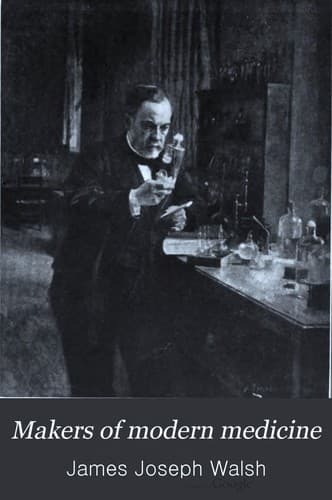
Makers of Modern MedicineWalsh, James J. (James Joseph)
History
Makers of Modern Medicine
Walsh, James J. (James Joseph)
Medicine -- Biography
Besides his interest in histology, the branch of anatomy which treats
of the intimate constitution of tissues, Schwann was working also at
certain general biological questions, and at some knotty problems of
physiology. Not long after his installation as an assistant at Berlin,
from observations on fermenting and decomposing organic liquids, he
came to a conclusion that was far in advance of the science of his
day. He announced definitely _infusoria non oriuntur generatione
aequivoca_--the infusoria do not originate by spontaneous generation.
Under the term infusoria, at that time, were included all the minute
organisms; so that Schwann's announcement was a definite rejection of
the doctrine of spontaneous generation over thirty years before
Pasteur's demonstrations finally settled the question. Schwann was
never a {262} controversialist. He took no part in the sometimes
bitter discussions that took place on the subject, but having stated
his views and the observations that had led up to them he did not ask
for the immediate acceptance of his conclusions. He continued his work
on other subjects, confident that truth would prevail in the end. When
the congratulations poured in on Pasteur for having utterly subverted
the doctrine of spontaneous generation, the great French scientist
generously referred the pioneer work on this subject to Schwann, and
sent felicitations to that effect when Schwann was celebrating the
jubilee anniversary of his professoriate.
While studying ferments and fermentations Schwann became interested in
certain functions of the human body that carry with them many
reminders of the biological processes which are at work in producing
the various alcohols and acids of fermentation. The changes that occur
in the contents of the human stomach during the preparation of food
for absorption had long been a subject of the greatest interest to
physiologists. It had been studied too much, however, from the merely
chemical side. The necessity for the presence of an acid in the
stomach contents in order that digestion should go on led to the
conclusion that the acid was the most important constituent of the
gastric juice. By means of the scrapings of the stomachs of various
animals Schwann succeeded in preparing an artificial gastric juice,
and showed just how the action of the gastric secretions brought about
the solution of the contents of the stomach. He isolated pepsin, and
demonstrated that it resembled very closely in its action the
substances known as ferments. He even hinted that digestion, instead
of being a chemical was a biological process. Any such explanation as
this was scouted by the chemists of the day, headed by Liebig. Most of
the physiological functions within the human body were {263} then
triumphantly claimed as examples of the working of chemical laws.
Public-domain text, read in full here on John Shaqi.
Reviews
Reviews
No reviews yet
Be the first to share your thoughts on this work.
Elsewhere in the archive
Join the Discussion
Join the discussion
Sign in to leave a comment or review.
Sign InorCreate an account