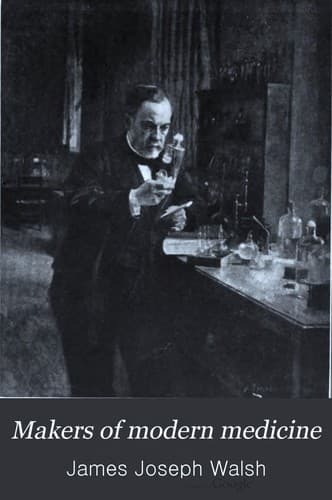
Makers of Modern MedicineWalsh, James J. (James Joseph)
History
Makers of Modern Medicine
Walsh, James J. (James Joseph)
Medicine -- Biography
Of the contradiction of his conclusions Schwann took practically no
notice, but went faithfully on with his work. He could not be lured
into controversy. For nearly five years he continued his work at the
University of Berlin, receiving only the pittance that has been
mentioned--less than ten dollars per month. Only the purest love of
science for its own sake, and the satisfaction of his own enthusiastic
spirit of investigation kept him at work. There was but little
prospect of advancement at the University of Berlin itself. Schwann
was one of the lowest in rank of the assistants; the professor was
only just beyond the prime of life; and before Schwann on the list for
promotion was at least one man, Henle, who had already done
distinguished work. Germany had the good fortune to have all during
the nineteenth century young men who, unmindful of present emolument,
had been satisfied with the scantest wages for their support, provided
the positions they occupied gave them opportunities for original work.
Even at the present day young medical men are glad to accept what they
consider the honor of the position of assistant to the professor and
director of the clinic, and to remain in it for from five to ten
years, sometimes even more, though the salary attached to it is only
from $250 to $400 per year. They well know that if their original
investigations into various medical questions are successful, advance
in university rank is assured. Their promotion seldom comes from the
institution where they have done their work, unless it should be one
of the smaller universities; but the invitation to a chair at a
university will come sooner or later for meritorious research.
Schwann's invitation came from Louvain. His work on cells had
attracted a great deal of attention. In the midst {264} of the
rationalism and infidelity then so common among scientific men Schwann
was known as a faithful, sincere Catholic. When the great Catholic
University of Louvain, then, looked around for a professor of anatomy,
he appeared to be the most suitable person. Henle, who had very little
sympathy for Schwann's religious views, speaks most kindly of him as a
man and a comrade. Schwann seems to have endeared himself to the
"difficult" Prussians, as he did to those around him all his life. For
the dominant note in the sketches of him by those who knew him
personally is that of heartiest friendship, joined with enthusiastic
admiration for his simple sincerity and unselfish devotion to his
friends and to science.
Public-domain text, read in full here on John Shaqi.
Reviews
Reviews
No reviews yet
Be the first to share your thoughts on this work.
Elsewhere in the archive
Join the Discussion
Join the discussion
Sign in to leave a comment or review.
Sign InorCreate an account