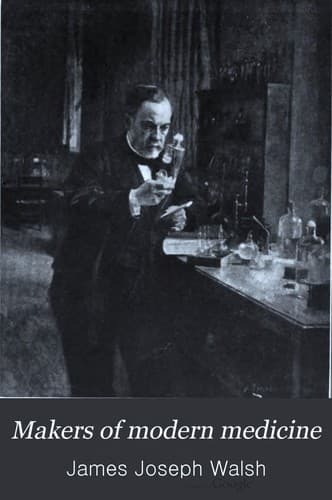
Makers of Modern MedicineWalsh, James J. (James Joseph)
History
Makers of Modern Medicine
Walsh, James J. (James Joseph)
Medicine -- Biography
A little incident that has been preserved for us by Henle shows how
much his young contemporaries appreciated even at that early date,
long before the full significance of the cell theory could be
realized, the aspect of Schwann's work which was to make him immortal.
At a little farewell dinner given him by his co-workers in various
laboratories of the University of Berlin the feature of the occasion
was a punning poem, by the toast-master, on the words Louvain and
cells.
In German Louvain is Löwen, which also means lion; that is, it is the
dative case of the name of the lion. Reference is made to the fact
that as Samson found honeycomb (in German, bee-cells) in the lion, so
now Louvain--_i.e._, in German, Löwen, the lion--finds a champion in
the man of the cells. As Samson's riddle was suggested by finding the
bee-cells, so will the new professor at Louvain solve the riddles of
science by the demonstration of cells. The youthful jesting seer
prophesied better than he knew. Schwann's first completed work at
Louvain was the _Microscopical Researches into the Accordance in
Structure and Growth of Plants and Animals._ [Footnote 11] {265} The
theory it advanced was to prove the most potent element thus far
introduced into biological science to help in the solution of the
difficult problems that constantly occur in the study of the various
forms of life.
[Footnote 11: Mikroskopische Untersuchung über die Uebereinstimmung
in der Structur und dem Wachsthum der Thiere und Pflanzen, 1839.]
At Louvain, Schwann remained for about ten years. The period is marked
by a continuance of his fruitful investigation of cell-life, of the
physiological biology of ferments and fermentation, and of the allied
subject of digestion in animals. His researches in Berlin on this
interesting and important subject, which was practically a complete
mystery at that time, had been mainly concerned with the gastric
juice. He now began the study of various secretions which aid
intestinal digestion. He proved that bile, which used to be considered
an excretion, was really an important digestive secretion. He was not
able to demonstrate the function of bile as completely as he had done
for the gastric juice. The problem of intestinal digestion is much
more complicated than that of stomach digestion, and involves a number
of factors for which allowance has to be made if the value of any one
of them is to be accurately determined. Even in our own day all of the
physiological problems in the functions of biliary secretion are not
solved. The greatest step was the demonstration that bile is a thing
whose presence in the intestines is to be encouraged, not because, as
Horace said, mental trouble was imminent unless one were purged of
black bile in the springtime, but because its presence insures the
proper preparation of food, and neutralizes in the intestinal tract
certain poisonous substances that if absorbed would prove sources of
irritation to all higher tissues.
Public-domain text, read in full here on John Shaqi.
Reviews
Reviews
No reviews yet
Be the first to share your thoughts on this work.
Elsewhere in the archive
Join the Discussion
Join the discussion
Sign in to leave a comment or review.
Sign InorCreate an account