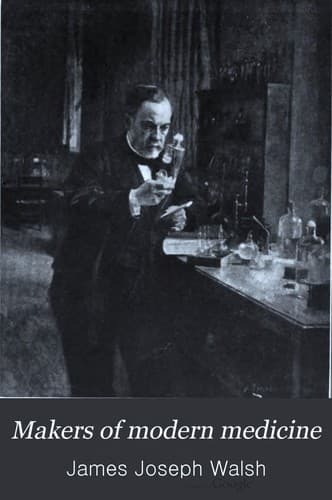
Makers of Modern MedicineWalsh, James J. (James Joseph)
History
Makers of Modern Medicine
Walsh, James J. (James Joseph)
Medicine -- Biography
Honors came to him, but left him modest as before. He was elected a
member of the French Academy--one of the forty immortals. Only five
times in the history of the Academy has the honor of membership been
conferred upon a medical man. Before Bernard, Flourens, the father of
brain physiology, had occupied a _fauteuil_, while Cabanis and Vicq
d'Azyr are two other names of medical immortals.
Bernard was elected to the 24th _fauteuil_, which had been occupied by
Flourens, and according to custom had to pronounce his predecessor's
panegyric. The conclusion of his address was the expression: "There is
no longer a line of demarcation between physiology and psychology."
Physiology had become the all-ruler for Bernard in human function, and
he drifted into what would have been simple materialism only for the
saving grace of his own utter sanity, his active imagination, and the
unconscious influence of early training. During his most successful
years of scientific investigation, wrapped up in his experiments and
their suggestions, Bernard was drawn far away from the spiritual side
of things. This partial view of man and nature could not endure,
however. In an article on Bernard in the _Revue des Questions
scientifiques_ for April, 1880, Father G. Hahn, S. J., says of him: "A
man of such uprightness of character could not be allowed to persist
to the end in this restless skepticism. His mental condition was
really a kind of vertigo caused by the {287} depths of nature that he
saw all around him. At the threshold of eternity he came back to his
true self and his good sense triumphed. The great physiologist died a
true Christian."
Bernard was one of the great thinkers of an age whose progress in
science will stamp it as one of the most successful periods of advance
in human thought. He accomplished much, but much more he seemed to
have divined. He seldom gave out the slightest hint of the tendencies
of his mind, or of his expectations of discovery in matters of
science, until fully satisfied that his theoretic considerations were
justified and confirmed by observation and experiment. In one thing,
however, he allowed favored friends to share some of his
anticipations, and the notes published after his death show that he
was on the very point of another great discovery in biology which has
since been made. He was a firm friend of Pasteur's, and had ably
seconded the great chemist-biologist's efforts to disprove spontaneous
generation. Bernard's demonstration that air passed through a tube
heated red hot might be suffered with impunity to come in contact with
any sort of organic material, yet would never cause the development of
germ life, was an important link in the proof that if life were
carefully destroyed, no life, however microscopic in character, would
develop unless the seeds of previously existent life were somehow
brought in contact with the organic matter.
Public-domain text, read in full here on John Shaqi.
Reviews
Reviews
No reviews yet
Be the first to share your thoughts on this work.
Elsewhere in the archive
Join the Discussion
Join the discussion
Sign in to leave a comment or review.
Sign InorCreate an account