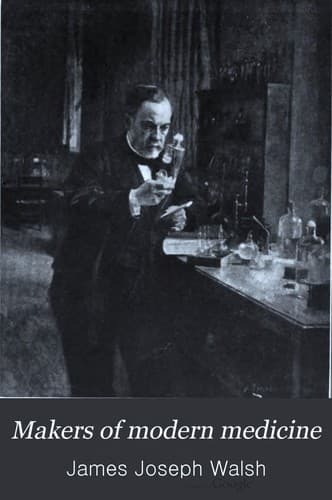
Makers of Modern MedicineWalsh, James J. (James Joseph)
History
Makers of Modern Medicine
Walsh, James J. (James Joseph)
Medicine -- Biography
With regard to fermentation, too, Bernard was for many years in close
accord with Pasteur, who taught that fermentation was the result of
the chemical activity of living cells, the ferments. Toward the end of
his life Bernard came to the view, however, that the action of
ferments was really due to the presence in them of chemically active
substances called diastases. These substances are of varied chemical
{288} composition, but each one has a constant formula. Their presence
in a fermentescible solution is sufficient of itself, even in the
absence of living cells, to bring about fermentation. It has since
been shown that after this substance is removed from ferment-cells by
pressure, and the liquid carefully filtered so that absolutely no
cells remain, fermentation will yet take place.
This does not disprove the necessity for life to produce the diastases
originally, though it advances science a step beyond the theory that
it is the actual vital interchange of nutritious substances within the
ferment-cell that causes fermentation. With each step of advance in
biological science the mystery of life and its processes deepens.
No one has done more to bring out the depths there are in vital
function than Bernard. His early training was of the type that is,
according to many prominent educators of our day, least calculated to
develop originality of view, or capacity for initiating new lines of
thought. Our pedagogic Solons would claim that the narrow orthodoxy
that wrapped itself around his developmental years must surely stifle
the precious genius for investigation that was in him. It is due, on
the contrary, very probably to the thorough conservatism of his early
training and the rounded fulness of the mental development acquired
under the old system of classical education, that we have to chronicle
of Bernard none of the errors by exaggeration of personal bias that
are so common among even great scientific men. Few successful men have
ever owed less to luck or to favoring circumstances in life. He was in
the best sense a self-made man, and he owed his success to a large
liberality of mind that enabled him to grasp things in their true
proportions. With an imaginative faculty that constantly outstripped
his experimental observations he was singularly free from prejudgment
and was able to {289} control his theories by what he found, never
allowing them to warp his powers of observation. Bernard is without
doubt the greatest example of the century that a fully rounded
youthful training is much more favorable to successful investigation
than the early specialization which is falsely supposed to foster it.
{290}
{291}
PASTEUR, FATHER OF PREVENTIVE MEDICINE
{292}
Public-domain text, read in full here on John Shaqi.
Reviews
Reviews
No reviews yet
Be the first to share your thoughts on this work.
Elsewhere in the archive
Join the Discussion
Join the discussion
Sign in to leave a comment or review.
Sign InorCreate an account