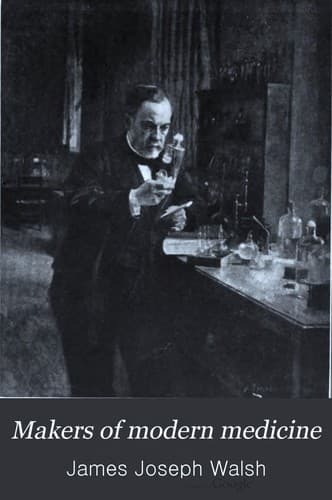
Makers of Modern MedicineWalsh, James J. (James Joseph)
History
Makers of Modern Medicine
Walsh, James J. (James Joseph)
Medicine -- Biography
Dr. O'Dwyer's originality in the invention of intubation has sometimes
been doubted. The idea of some such instrumental procedure as he
finally perfected seems to have occurred to practitioners of medicine
a number of times in medical history. No one reduced the idea to
practice in any successful degree. O'Dwyer's invention was not some
chance hit of good fortune in lighting on a brilliant idea, but the
result of years of patient investigation and shaping of means to ends.
Often failure seemed inevitable, but he continued to experiment until
he forced the hand of the goddess of invention to be favorable to him.
The history of intubation is interesting mainly because it brings out
clearly O'Dwyer's success where others had failed.
The evolution of intubation forms, moreover, a very interesting
chapter in the story of medicine. It is curious to learn that the
Greeks of the classical period, and very probably for a long time
before, knew something of the possibility of putting a tube into the
larynx in cases of stenoses or contractions which threatened to
prevent breathing. It is clear that they thus secured patency of the
air-passages after these had become occluded. Hippocrates mentions
{336} canalization of the air-passages, and suggests that in
inflammatory croup with difficulty of respiration, canulas should be
carried into the throat along the jaws so that air could be drawn into
the lungs. This is probably diphtheria, the first mention of the
disease in medical literature, though it is usually said to have been
first described in Spain at the beginning of the nineteenth century.
There is evidence, too, in Greek medical history that these directions
were followed by many practising physicians of those early times.
Considering that intubation of the larynx is usually thought to be a
very modern treatment, this tradition in Greek medical history serves
to show how transitory may be the effect of real progress in applied
science. After a time the Asclepiades, and some centuries later
Paulinus of AEginetus, rejected the teaching of Hippocrates in this
matter, while the latter suggested even the employment of bronchotomy.
Public-domain text, read in full here on John Shaqi.
Reviews
Reviews
No reviews yet
Be the first to share your thoughts on this work.
Elsewhere in the archive
Join the Discussion
Join the discussion
Sign in to leave a comment or review.
Sign InorCreate an account