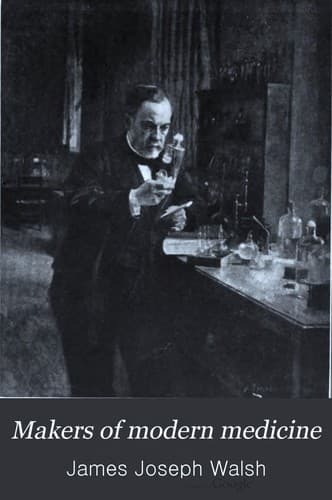
Makers of Modern MedicineWalsh, James J. (James Joseph)
History
Makers of Modern Medicine
Walsh, James J. (James Joseph)
Medicine -- Biography
After this episodic existence among the Greeks, there is no mention of
anything like intubation of the larynx until about the beginning of
the nineteenth century. In 1801, Desault, a French surgeon, while
attempting to feed a patient suffering with a stricture of the
oesophagus through a tube passed down the throat, inadvertently
allowed the tube to pass into the larynx. This brought on a severe fit
of coughing, but after a time the tube was tolerated and an attempt
was made to feed the patient through it, with the production (as can
be readily imagined) of a very severe spasmodic laryngeal attack.
Desault realized the probable position of the tube then, and, taking a
practical hint from this accident, suggested that possibly tubes could
be passed down into the lungs even through a spasmodically contracted
or infiltrated larynx, with the consequent assurance of free ingress
of air. As these cases were otherwise extremely {337} hopeless, it was
not long before he found the opportunity to put his hypothesis to the
test, and in some half a dozen cases he succeeded in lengthening
patient's lives and making them more comfortable for some hours at
least.
Desault's suggestion was followed by similarly directed experiments on
the part of Chaussier, Ducasse and Patissier. All these came during
the first quarter of the century in France, while, in 1813, Finaz of
Seyssel, a student of the University of Paris, in writing his
graduation thesis for the faculty of medicine, suggested the use of a
gum-elastic tube that should be passed down into the larynx in order
to allow the passage of air in spasmodic and other obstructive
conditions. In 1820, Patissier suggested that some such remedy as this
should be employed for edema of the glottis. This affection, which is
apt to be rapidly fatal, is a closing of the chink of the glottis, or
_rima glottidis_, as it is called, which occurs very rapidly as the
result of inflammatory conditions, especially in patients who are
suffering from some kidney affection.
There was no doubt in the mind of practitioners generally of the
necessity in many cases for some such expedient as the intubation of
the larynx, but there was a very generally accepted notion that the
mucous membrane of the larynx was entirely too sensitive to permit of
a tube remaining for any considerable length of time in contact with
the vocal cords and the very sensitive mucous membrane of the
epiglottis. Meantime many precious lives were lost. Our own Washington
was a sufferer, perhaps, from inflammatory edema of the larynx,
complicated by a kidney trouble, though this was thirty years before
Bright's work, and (as a matter of course) we have no definite data in
the matter; or, as seems not unlikely, he suffered from a severe
attack of laryngeal diphtheria, and, after hours of intense dyspnoea,
{338} suffocated while his physicians stood hopelessly by, unable to
do anything for him.
Public-domain text, read in full here on John Shaqi.
Reviews
Reviews
No reviews yet
Be the first to share your thoughts on this work.
Elsewhere in the archive
Join the Discussion
Join the discussion
Sign in to leave a comment or review.
Sign InorCreate an account