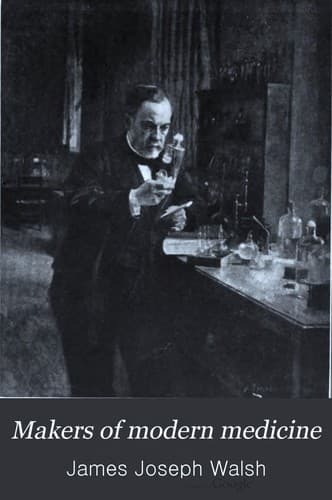
Makers of Modern MedicineWalsh, James J. (James Joseph)
History
Makers of Modern Medicine
Walsh, James J. (James Joseph)
Medicine -- Biography
Naturally he was of a rather melancholic tendency, prone to dwell on
the sadder side of things, and was constantly interested in sad
stories and songs. He liked sad music, {353} and usually refused to
listen to the livelier airs that others, especially of his race, were
apt to find so refreshing. Something of this sterner side of his
character entered into all his relations with others, and even with
his own family. Though deeply affectionate, he very seldom permitted
them to see and appreciate that fact. He was rather apt to be stern
than otherwise, fearful lest his affection should in any way spoil
them. To the very young children, in whose regard he did not consider
this objection to hold, he was almost demonstratively affectionate,
and those who knew his love for little children appreciated the
sacrifice he made in denying himself demonstrations of affection to
his own.
With all his sadness there was, as might be expected from his racial
descent, a vein of dry humor, not infrequently manifest, though only
to very near friends. He appreciated a good story, though the
slightest tendency to vulgarity was extremely displeasing to him. He
is said to be the originator of the humorous expression that has since
been used often enough. While one day calling at a friend's house, in
the absence of the friend, the servant asked him to leave his name,
but was met with the reply (from the doctor) that "he preferred not
to, as he thought he might have use for it before he got home."
The religious side of O'Dwyer's character is intensely interesting,
because it represents a successful professional man--the maker of an
important discovery in medicine; a logical, scientific thinker, whose
opinion was valued by all his professional brethren--as one of the
simplest of believers, tenderly pious and faithful. The sexton of the
church near which he lived tells (since his death) of frequently
seeing him steal in during the day to say his prayers at the foot of
the altar. He was one of the most faithful attendants at the
communions and retreats of the Xavier Alumni Sodality {354} of New
York City, of which he was an enthusiastic member. His deep piety can,
perhaps, be best appreciated from a characteristic incident, which
illustrates his faith in prayer--his confidence in Providence. He had
asked for something with regard to one of his children over and over
again, and finally thought that his prayer had been heard. Later on he
had reason to regret the fact that his wish had been granted, and to a
friend, to whom he told the circumstances, he said:
"All that we can do is to say with resignation, 'Thy will be done,'
and then we shall be sure that whatever happens will be for the
best."
Public-domain text, read in full here on John Shaqi.
Reviews
Reviews
No reviews yet
Be the first to share your thoughts on this work.
Elsewhere in the archive
Join the Discussion
Join the discussion
Sign in to leave a comment or review.
Sign InorCreate an account