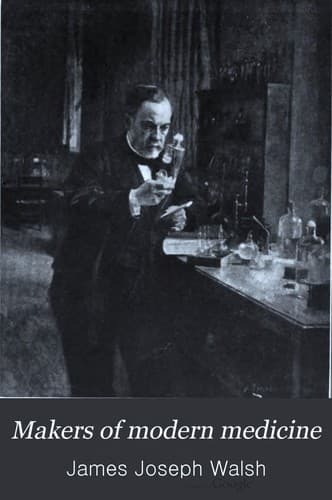
Makers of Modern MedicineWalsh, James J. (James Joseph)
History
Makers of Modern Medicine
Walsh, James J. (James Joseph)
Medicine -- Biography
At the time of his death he was about fifty-seven years of age. He had
reached the maturity of his powers, and with the consciousness of
having accomplished one good work was ready for further original
investigations in practical medicine. A thought that had occupied him
very much toward the end of his life was the possibility of a
mechanical method of treating pneumonia. He had made a series of
experiments on the lungs, and many clinical observations with regard
to the possibility of producing over-inflation by mechanical measures.
He confided to one of his physician friends, who had been closest to
him during life, that he hoped thus to secure a method of treating
pneumonia successfully. This, after all, is the most serious problem
in present-day medicine. Our death-rate from pneumonia is at least as
high now as it was a century ago. O'Dwyer started from the observation
that those suffering from emphysema seldom develop true pneumonia. And
he hoped {356} to prevent the progress of the disease, or to abort it
in its inception, by producing artificial emphysema for the time
being. Had he lived, it seems not unlikely that we would have had
further original work of a high order from him.
Though of Irish descent, Dr. O'Dwyer illustrated very well the
expression that was used of the English nobility who went to Ireland
in Elizabeth's time, and who are said to have become "more Irish than
the Irish themselves." O'Dwyer became an American of the Americans. He
believed in meeting Americans on their own ground, cultivating their
acquaintance, and making them realize the worth of new citizens of the
republic by showing them how sincere was the patriotism of their
recently admitted compatriots.
Dr. O'Dwyer was in everything the model of a Christian gentleman, and
an exemplary member of the great humanitarian profession whose
charitable opportunities he knew how to find and take advantage of at
every turn in life. The American medical profession has never had a
more worthy model of all that can be expected from physicians in their
philanthropic duties toward suffering humanity, nor a better exemplar
of what Christian manhood means in the widest sense of that expressive
term. With an inventive genius of a high order, that gave him a
prominent place in a great generation and that has stamped his name on
the roll of medical fame for all time, there were united the simple
faith, the earnest purpose, the clear-sighted judgment and the feeling
kindness--those supreme qualities of head and heart that will always
secure for him a prominent place in the small group of great medical
men.
{357}
INDEX.
Public-domain text, read in full here on John Shaqi.
Reviews
Reviews
No reviews yet
Be the first to share your thoughts on this work.
Elsewhere in the archive
Join the Discussion
Join the discussion
Sign in to leave a comment or review.
Sign InorCreate an account