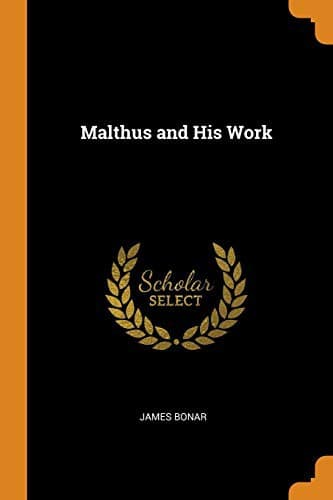
Malthus, T. R. (Thomas Robert), 1766-1834; Malthusianism
This caricature had enough truth in it to save it from instant
detection, and its vitality is due to the superior ease in
understanding, and therefore greater pleasure in hearing, a blank denial
or a blank affirmation as compared with the necessary qualifications of
a scientific statement. The truth must be told, however, that Malthus
and the rest of the learned world were by no means at utter discord. He
always treated a hostile economist as a possible ally. He was carrying
on the work of their common Founder. In the _Essay on Population_ he was
inquiring into the nature and causes of poverty, as Adam Smith had
inquired into the nature and causes of wealth. But Malthus himself did
not intend the one to be a mere supplement to the other. He did not
approach the subject from a purely scientific side. He had not devoted
long years of travel and reflection to the preparation of an economical
treatise. Adam Smith had written his _Moral Sentiments_ seventeen years
before his greater work. When he wrote the latter he had behind him an
academical and literary reputation; and he satisfied the just
expectations of the public by giving them, in the two quarto volumes of
the _Wealth of Nations_, his full-formed and completely digested
conclusions and reasonings definitively expressed (1776). Malthus, on
the contrary, gained his reputation by a bold and sudden stroke, well
followed up. His _Essay_ was an anonymous pamphlet in a political
controversy, and was meant to turn the light of political economy upon
the political philosophy of the day. Whatever the essay contained over
and above politics, and however far afield the author eventually
travelled in the later editions, there is no doubt about the first
origin of the essay itself. It was not, as we are sometimes told, that,
being a kind-hearted clergyman, he set himself to work to inquire
whether after all it was right to increase the numbers of the population
without caring for the quality of it. In 1798 Malthus was no doubt in
holy orders and held a curacy at Albury; but he seems never to have been
more than a curate. The Whigs offered him a living in his later years,
but he passed it to his son;[5] and we should be far astray if we
supposed his book no more than the “recreations of a country parson.”
“Parson” was in his case a title without a _rôle_ and Cobbett’s immortal
nickname is very unhappy.[6] He had hardly more of the parson than
Condillac of the abbé. In 1798 Pitt’s Bill for extending relief to large
families, and thereby encouraging population, was no doubt before the
country; but we owe the essay not to William Pitt, but to William
Godwin. The changed aspect of the book in its later editions need not
blind us to the efficient cause of its first appearance.
Public-domain text, read in full here on John Shaqi.
Reviews
Reviews
No reviews yet
Be the first to share your thoughts on this work.
Join the Discussion
Join the discussion
Sign in to leave a comment or review.
Sign InorCreate an account