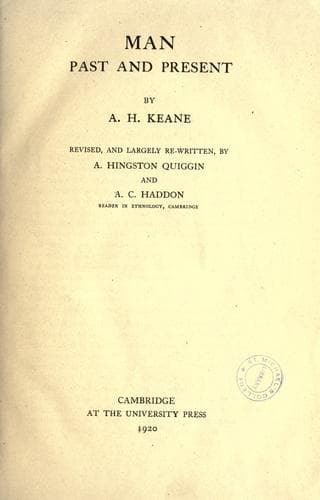
Man, Past and PresentKeane, A. H. (Augustus Henry)
History
Man, Past and Present
Keane, A. H. (Augustus Henry)
Anthropology; Ethnology
The French and Swiss Protestant teachers have also achieved great things
in Basutoland, where they were welcomed by Moshesh, the founder of the
present Basuto nation. The tribal system has yielded to a higher social
organisation, and the Ba-Tau, Ba-Puti, and several other tribal groups
have been merged in industrious pastoral and agricultural communities
professing a somewhat strict form of Protestant Christianity, and
entirely forgetful of the former heathen practices associated with
witchcraft and ancestry-worship. Moshesh was one of the rare instances
among the Kafirs of a leader endowed with intellectual gifts which
placed him on a level with Europeans. He governed his people wisely and
well for nearly fifty years, and his life-work has left a permanent mark
on South African history[269].
In Bechuanaland one great personality dominates the social horizon.
Khama, king of the Ba-Mangwato nation, next to the Ba-Rotse the most
powerful section of the Be-Chuana, may be described as a true father of
his people, a Christian legislator in the better sense of the term, and
an enlightened reformer even from the secular point of view.
When these triumphs, analogous to those witnessed amongst the
Lacustrians and in other parts of Bantuland, are contrasted with the
dull weight of resistance everywhere opposed by the full-blood Negro
populations to any progress beyond their present low level of culture,
we are the better able to recognise the marked intellectual superiority
of the negroid Bantu over the pure black element.
West of Bechuanaland the continuity of the Bantu domain is arrested in
the south by the Hottentots, who still hold their ground in Namaqualand,
and farther north by the few wandering Bushman groups of the Kalahari
desert. Even in Damaraland, which is mainly Bantu territory, there are
interminglings of long standing that have given rise to much ethnical
confusion. The Ova-Herero, who were here dominant, and the kindred
Ova-Mpo of Ovampoland bordering on the Portuguese possessions, are
undoubted Bantus of somewhat fine physique, though intellectually not
specially distinguished. Owing to the character of the country, a
somewhat arid, level steppe between the hills and the coast, they are
often collectively called "Cattle Damaras," or "Damaras of the Plains,"
in contradistinction to the "Hill Damaras" of the coast ranges. To this
popular nomenclature is due the prevalent confusion regarding these
aborigines. The term "Damara" is of Hottentot origin, and is not
recognised by the local tribes, who all call themselves Ova-Herero, that
is, "Merry People." But there is a marked difference between the
lowlanders and the highlanders, the latter, that is, the "Hill Damaras,"
having a strong strain of Hottentot blood, and being now of Hottentot
speech.
Public-domain text, read in full here on John Shaqi.
Reviews
Reviews
No reviews yet
Be the first to share your thoughts on this work.
Elsewhere in the archive
Join the Discussion
Join the discussion
Sign in to leave a comment or review.
Sign InorCreate an account