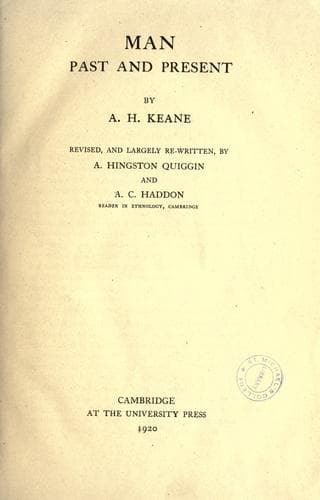
Man, Past and PresentKeane, A. H. (Augustus Henry)
History
Man, Past and Present
Keane, A. H. (Augustus Henry)
Anthropology; Ethnology
Referring to these stirring events, Mackenzie writes: "Thus perished the
Makololo from among the number of South African tribes. No one can put
his finger on the map of Africa and say, 'Here dwell the
Makololo[266].'" This will puzzle many who since the middle of the
nineteenth century have repeatedly heard of, and even been in
unpleasantly close contact with, Ma-Kololo so called, not indeed in
Barotseland, but lower down the Zambesi about its Shire affluent.
The explanation of the seeming contradiction is given by another
incident, which is also not without ethnical significance. From
Livingstone's _Journals_ we learn that in 1859 he was accompanied to the
east coast by a small party of Ma-Kololo and others, sent by his friend
Sekeletu in quest of a cure for leprosy, from which the emperor was
suffering. These Ma-Kololo, hearing of the Ba-Rotse revolt, wisely
stopped on their return journey at the Shire confluence, and through the
prestige of their name have here succeeded in founding several so-called
"Makololo States," which still exist, and have from time to time given
considerable trouble to the administrators of British Central Africa.
But how true are Mackenzie's words, if the political be separated from
the ethnical relations, may be judged from the fact that of the original
founders of these petty Shire states only two were full-blood Ma-Kololo.
All the others were, I believe, Ba-Rotse, Ba-Toka, or Ba-Tonga, these
akin to the savage Ba-Shukulumbwe.
Thus the Ma-Kololo live on, in their speech above the Victoria Falls, in
their name below the Victoria Falls, and it is only from history we know
that since about 1870 the whole nation has been completely wiped out
everywhere in the Zambesi valley. But even amongst cultured peoples
history goes back a very little way, 10,000 years at most anywhere. What
changes and shiftings may, therefore, have elsewhere also taken place
during prehistoric ages, all knowledge of which is now past
recovery[267]!
Few Bantu peoples have lent a readier ear to the teachings of Christian
propagandists than the Xosa, Ba-Suto, and Be-Chuana natives. Several
stations in the heart of Kafirland--Blythswood, Somerville, Lovedale,
and others--have for some time been self-supporting, and prejudice alone
would deny that they have worked for good amongst the surrounding Gaika,
Galeka, and Fingo tribes. Sogo, a member of the Blythswood community,
has produced a translation of the _Pilgrim's Progress_, described by J.
Macdonald as "a marvel of accuracy and lucidity of expression[268]";
numerous village schools are eagerly attended, and much land has been
brought under intelligent cultivation.
Public-domain text, read in full here on John Shaqi.
Reviews
Reviews
No reviews yet
Be the first to share your thoughts on this work.
Elsewhere in the archive
Join the Discussion
Join the discussion
Sign in to leave a comment or review.
Sign InorCreate an account