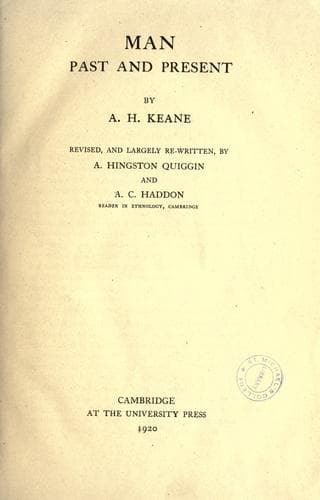
Man, Past and PresentKeane, A. H. (Augustus Henry)
History
Man, Past and Present
Keane, A. H. (Augustus Henry)
Anthropology; Ethnology
When first heard of by Bowdich in 1819, the Paaemways, as he calls the
Fans, were an inland people presenting such marked Hamitic or Caucasic
features that he allied them with the West Sudanese Fulahs. Since then
there have been inevitable interminglings, by which the type has no
doubt been modified, though still presenting distinct non-Bantu or
non-Negro characters. Burton, Winwood Reade, Oscar Lenz and most other
observers separate them altogether from the Negro connection, describing
them as "well-built, tall and slim, with a light brown complexion, often
inclining to yellow, well-developed beard, and very prominent frontal
bone standing out in a semicircular protuberance above the superciliary
arches. Morally also, they differ greatly from the Negro, being
remarkably intelligent, truthful, and of a serious temperament, seldom
laughing or indulging in the wild orgies of the blacks[282]."
M. H. Kingsley adds that "the average height in mountain districts is
five feet six to five feet eight (1.67 m. to 1.72 m.), the difference in
stature between men and women not being great. Their countenances are
very bright and expressive, and if once you have been among them, you
can never mistake a Fan. The Fan is full of fire, temper, intelligence
and go; very teachable, rather difficult to manage, quick to take
offence and utterly indifferent to human life." The cannibalism of the
Fans, though a prevalent habit, is not, according to Miss Kingsley, due
to sacrificial motives. "He does it in his common sense way. He will eat
his next door neighbour's relations and sell his own deceased to his
next door neighbour in return; but he does not buy slaves and fatten
them up for his table as some of the Middle Congo tribes do.... He has
no slaves, no prisoners of war, no cemeteries, so you must draw your own
conclusions[283]." The Fan language has been grouped by Sir H. H.
Johnston among Bantu tongues, but he describes it as so corrupt as to be
only just recognisable as Bantu. In linguistic, physical and mental
features they thus show a remarkable divergence from the pure Negro,
suggesting Hamitic probably Fulah elements.
In the Camerun region, which still lies within Bantu territory, Sir H.
H. Johnston[284] divides the numerous local tribes into two groups, the
aborigines, such as the _Ba-Yong_, _Ba-Long_, _Ba-Sa_, _Abo_ and _Wuri_;
and the later intruders--_Ba-Kundu_, _Ba-Kwiri_, _Dwala_, "_Great
Batanga_" and _Ibea_--chiefly from the east and south-east. Best known
are the Dwalas of the Camerun estuary, physically typical Bantus with
almost European features, and well-developed calves, a character which
would alone suffice to separate them from the true Negro. Nor are these
traits due to contact with the white settlers on the coast, because the
Dwalas keep quite aloof, and are so proud of their "blue blood," that
till lately all half-breeds were "weeded-out," being regarded as
monsters who reflected discredit on the tribe[285].
Public-domain text, read in full here on John Shaqi.
Reviews
Reviews
No reviews yet
Be the first to share your thoughts on this work.
Elsewhere in the archive
Join the Discussion
Join the discussion
Sign in to leave a comment or review.
Sign InorCreate an account