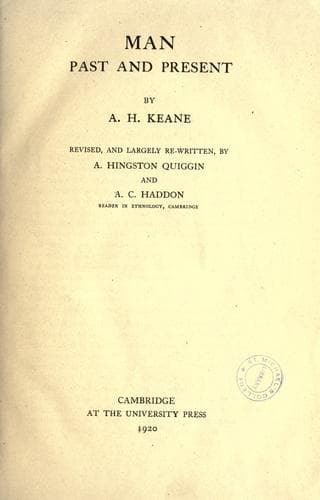
Man, Past and PresentKeane, A. H. (Augustus Henry)
History
Man, Past and Present
Keane, A. H. (Augustus Henry)
Anthropology; Ethnology
Socially the Camerun natives stand at nearly the same low level of
culture as the neighbouring full-blood Negroes of the Calabar and Niger
delta. Indeed the transition in customs and institutions, as well as in
physical appearance, is scarcely perceptible between the peoples
dwelling north and south of the Rio del Rey, here the dividing line
between the Negro and Bantu lands. The _Ba-Kish_ of the Meme river,
almost last of the Bantus, differ little except in speech from the Negro
_Efiks_ of Old Calabar, while witchcraft and other gross superstitions
were till lately as rife amongst the Ba-Kwiri and Ba-Kundu tribes of the
western Camerun as anywhere in Negroland. It is not long since one of
the Ba-Kwiri, found guilty of having eaten a chicken at a missionary's
table, was himself eaten by his fellow clansmen. The law of blood for
blood was pitilessly enforced, and charges of witchcraft were so
frequent that whole villages were depopulated, or abandoned by their
terror-stricken inhabitants. The island of Ambas in the inlet of like
name remained thus for a time absolutely deserted, "most of the
inhabitants having poisoned each other off with their everlasting
ordeals, and the few survivors ending by dreading the very air they
breathed[286]."
Having thus completed our survey of the Bantu populations from the
central dividing line about the Congo-Chad water-parting round by the
east, south, and west coastlands, and so back to the Sudanese zone, we
may pause to ask, What routes were followed by the Bantus themselves
during the long ages required to spread themselves over an area
estimated at nearly six million square miles? I have established,
apparently on solid grounds, a fixed point of initial dispersion in the
extreme north-east, and allusion has frequently been made to migratory
movements, some even now going on, generally from east to west, and, on
the east side of the continent, from north to south, with here an
important but still quite recent reflux from Zululand back nearly to
Victoria Nyanza. If a parallel current be postulated as setting on the
Atlantic side in prehistoric times from south to north, from Hereroland
to the Cameruns, or possibly the other way, we shall have nearly all the
factors needed to explain the general dispersion of the Bantu peoples
over their vast domain.
Support is given to this view by the curious distribution of the two
chief Bantu names of the "Supreme Being," to which incidental reference
has already been made. As first pointed out I think by Dr Bleek,
_(M)unkulunkulu_ with its numerous variants prevails along the eastern
seaboard, _Nzambi_ along the western, and both in many parts of the
interior; while here and there the two meet, as if to indicate
prehistoric interminglings of two great primeval migratory movements.
From the subjoined table a clear idea may be had of the general
distribution:
MUNKULUNKULU NZAMBI
Public-domain text, read in full here on John Shaqi.
Reviews
Reviews
No reviews yet
Be the first to share your thoughts on this work.
Elsewhere in the archive
Join the Discussion
Join the discussion
Sign in to leave a comment or review.
Sign InorCreate an account