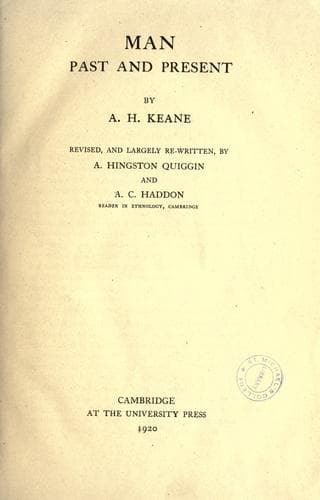
Man, Past and PresentKeane, A. H. (Augustus Henry)
History
Man, Past and Present
Keane, A. H. (Augustus Henry)
Anthropology; Ethnology
Farther south a widely-diffused Hottentot-Bushman geographical
terminology attests the former range of this primitive race all over
South Africa, as far north as the Zambesi. Lichtenstein had already
discovered such traces in the Zulu country[309], and Vater points out
that "for some districts the fact has been fully established; mountains
and rivers now occupied by the Koossa [Ama-Xosa] preserve in their
Hottentot names the certain proof that they at one time formed a
permanent possession of this people[310]."
Thanks to the custom of raising heaps of stones or cairns over the
graves of renowned chiefs, the migrations of the Hottentots may be
followed in various directions to the very heart of South Zambesia. Here
the memory of their former presence is perpetuated in the names of such
water-courses as Nos-ob, Up, Mol-opo, Hyg-ap, Gar-ib, in which the
syllables _ob_, _up_, _ap_, _ib_ and others are variants of the
Hottentot word _ib_, _ip_, water, river, as in _Gar-ib_, the "Great
River," now better known as the Orange River. The same indications may
be traced right across the continent to the Atlantic, where nearly all
the coast streams--even in Hereroland, where the language has long been
extinct--have the same ending[311].
On the west side the Bushmen are still heard of as far north as the
Cunene, and in the interior beyond Lake Ngami nearly to the right bank
of the Zambesi. But the Hottentots are now confined mainly to Great and
Little Namaqualand. Elsewhere there appear to be no full-blood natives
of this race, the Koraquas, Gonaquas, Griquas, etc. being all
Hottentot-Boer or Hottentot-Bantu half-castes of Dutch speech. In Cape
Colony the tribal organisation ceased to exist in 1810, when the last
Hottentot chief was replaced by a European magistrate. Still the
Koraquas keep themselves somewhat distinct about the Upper Orange and
Vaal Rivers, and the Griquas in Griqualand East, while the Gonaquas,
that is, "Borderers," are being gradually merged in the Bantu
populations of the Eastern Provinces. There are at present scarcely
180,000 south of the Orange River, and of these the great majority are
half-breeds[312].
Public-domain text, read in full here on John Shaqi.
Reviews
Reviews
No reviews yet
Be the first to share your thoughts on this work.
Elsewhere in the archive
Join the Discussion
Join the discussion
Sign in to leave a comment or review.
Sign InorCreate an account