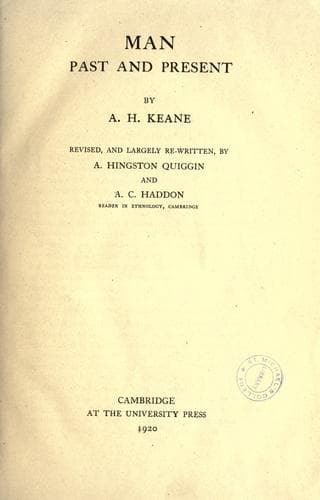
Man, Past and PresentKeane, A. H. (Augustus Henry)
History
Man, Past and Present
Keane, A. H. (Augustus Henry)
Anthropology; Ethnology
Despite their extremely low state of culture, or, one might say, the
almost total lack of culture, the Bushmen are distinguished by two
remarkable qualities, a fine sense of pictorial or graphic art[313], and
a rich imagination displayed in a copious oral folklore, much of which,
collected by Bleek, is preserved in manuscript form in Sir George Grey's
library at Cape Town[314]. The materials here stored for future use,
perhaps long after the race itself has vanished for ever, comprise no
less than 84 thick volumes of 3600 double-column pages, besides an
unfinished Bushman dictionary with 11,000 entries. There are two great
sections, (1) Myths, fables, legends and poetry, with tales about the
sun and moon, the stars, the _Mantis_ and other animals, legends of
peoples who dwelt in the land before the Bushmen, songs, charms, and
even prayers; (2) Histories, adventures of men and animals, customs,
superstitions, genealogies, and so on.
In the tales and myths the sun, moon, and animals speak either with
their own proper clicks, or else use the ordinary clicks in some way
peculiar to themselves. Thus Bleek tells us that the tortoise changes
clicks in labials, the ichneumon in palatals, the jackal substitutes
linguo-palatals for labials, while the moon, hare, and ant-eater use
"a most unpronounceable click" of their own. How many there may be
altogether, not one of which can be properly uttered by Europeans,
nobody seems to know. But grammarians have enumerated nine, indicated
each by a graphic sign as under:
Cerebral [Symbol] Palatal [Symbol]
Dental [Symbol] Lateral (Faucal) [Symbol]
Guttural [Symbol] Labial [Symbol]
Spiro-dental [Symbol] Linguo-palatal [Symbol]
Undefined [Symbol]
From Bushman--a language in a state of flux, fragmentary as the small
tribal or rather family groups that speak it[315]--these strange
inarticulate sounds passed to the number of four into the remotely
related Hottentot, and thence to the number of three into the wholly
unconnected Zulu-Xosa. But they are heard nowhere else to my knowledge
except amongst the newly-discovered Wa-Sandawi people of South
Masailand. At the same time we know next to nothing of the Negrillo
tongues, and should clicks be discovered to form an element in their
phonetic system also[316], it would support the assumption of a common
origin of all these dwarfish races now somewhat discredited on
anatomical grounds.
Public-domain text, read in full here on John Shaqi.
Reviews
Reviews
No reviews yet
Be the first to share your thoughts on this work.
Elsewhere in the archive
Join the Discussion
Join the discussion
Sign in to leave a comment or review.
Sign InorCreate an account