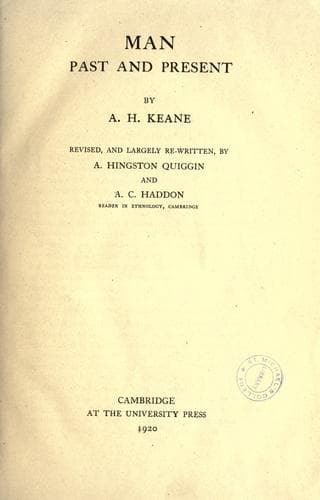
Man, Past and PresentKeane, A. H. (Augustus Henry)
History
Man, Past and Present
Keane, A. H. (Augustus Henry)
Anthropology; Ethnology
The Mousterian industry is entirely distinct from its predecessors. The
warm fauna has disappeared, the reindeer first occurs together with the
musk ox, arctic fox, the marmot and other cold-loving animals. Man
appears to have sought refuge in the caves, and from complete skeletons
found in cave deposits of this stage we gain the first clear ideas
concerning the physical type of man of the early palaeolithic period.
Typical Mousterian implements consist of leaf-like or triangular points
made from flakes struck from the nodule instead of from the dressed
nodule itself, as in the earlier stages. The Levallois flakes, occurring
at the base of the Mousterian (sometimes included in the Acheulean
stage), initiate this new style of workmanship, but the Mousterian point
shows an improvement in shape and a greater mastery in technique,
producing a more efficient tool for piercing and cutting. Scrapers,
carefully retouched, with a curved edge are also characteristic, besides
many other forms. The complete skeletons from Le Moustier itself, La
Chapelle, La Ferassie, and Krapina all belong to this stage, which marks
the end of the lower palaeolithic period, the Age of the Mammoth.
The upper palaeolithic or Reindeer Age is divided into Aurignacian,
Solutrian, and Magdalenian[45] culture stages, with the Azilian[46]
separating the Magdalenian from the neolithic period. Each stage is
distinguished by its implements and its art. The Aurignacian fauna,
though closely resembling the Mousterian, indicates an amelioration of
climate, the most abundant animals being the bison, horse, cave lion,
and cave hyena, and human settlements are again found in the open. Among
the typical implements are finely worked knife-like blades (Chatelperron
point, Gravette point), keeled scrapers (Tarte type), _burins_ or
gravers, and various tools and ornaments of bone. Art is represented by
engravings and wall paintings, and to this stage belong statuettes
representing nude female figures such as those of Brassempouy, Mentone,
Pont-a-Lesse (Belgium), Predmost and Willendorf, near Krems. The
Neandertal type appears to have died out and Aurignacian man belongs to
the modern type represented at Combe Capelle. If the evidence of the
figurines is to be accepted, a steatopygous race was at this time in
existence, which Sollas is inclined to connect with the Bushmen[47].
The Solutrian stage is characterised by the abundance of the horse,
replaced in the succeeding period by the reindeer. The Solutrians seem
to have been a warlike steppe people who came from the east into western
Europe. Their subsequent fate has not been elucidated. The culture
appears to have had a limited range, only a few stations being found
outside Dordogne and the neighbouring departments. The technique, as
shown in the laurel-leaf and willow-leaf points, exhibits a perfection
of workmanship unequalled in the Palaeolithic Age, and only excelled by
late prehistoric knives of Egypt.
Public-domain text, read in full here on John Shaqi.
Reviews
Reviews
No reviews yet
Be the first to share your thoughts on this work.
Join the Discussion
Join the discussion
Sign in to leave a comment or review.
Sign InorCreate an account