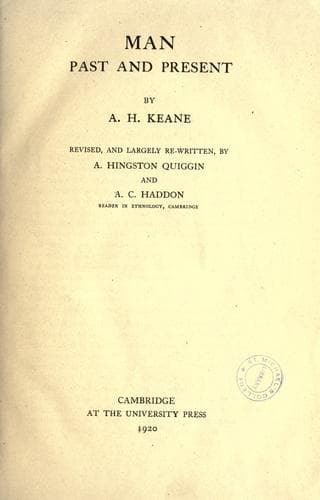
Man, Past and PresentKeane, A. H. (Augustus Henry)
History
Man, Past and Present
Keane, A. H. (Augustus Henry)
Anthropology; Ethnology
We may conclude with the words of W. J. Sollas: "The more we know of
these wonderful little people the more we learn to admire and like them.
To many solid virtues--untiring energy, boundless patience, and fertile
invention, steadfast courage, devoted loyalty, and family
affection--they added a native refinement of manners and a rare
aesthetic sense. We may learn from them how far the finer excellences of
life may be attained in the hunting stage. In their golden age, before
the coming of civilised man, they enjoyed their life to the full, glad
with the gladness of primeval creatures. The story of their later days,
their extermination and the cruel manner of it, is a tale of horror on
which we do not care to dwell. They haunt no more the sunlit veldt,
their hunting is over, their nation is destroyed; but they leave behind
an imperishable memory, they have immortalised themselves in their
art[318]."
FOOTNOTES:
[223] C. Meinhof holds that Proto-Bantu arose through the mixture of a
Sudan language with one akin to Fulah. _An Introduction to the Study of
African Languages_, 1915, p. 151 sqq.
[224] Bantu, properly Aba-ntu, "people." _Aba_ is one of the numerous
personal prefixes, each with its corresponding singular form, which are
the cause of so much confusion in Bantu nomenclature. To _aba_, _ab_,
_ba_ answers a sing. _umu_, _um_, _mu_, so that sing. _umu-ntu_,
_um-ntu_ or _mu-ntu_, a man, a person; plu. _aba-ntu_, _ab-ntu_, ba-ntu.
But in some groups mu is also plural, the chief dialectic variants
being, _Ama_, _Aba_, _Ma_, _Ba_, _Wa_, _Ova_, _Va_, _Vua_, _U_, _A_,
_O_, _Eshi_, as in Ama-Zulu, Mu-Sarongo, Ma-Yomba, Wa-Swahili,
Ova-Herero, Vua-Twa, Ba-Suto, Eshi-Kongo. For a tentative classification
of African tribes see T. A. Joyce, Art. "Africa: Ethnology," _Ency.
Brit._ 1910, p. 329. For the classification of Bantu tongues into 44
groups consult H. H. Johnston, Art. "Bantu Languages," _loc. cit._
[225] _Eth._ Ch. XI.
[226] _Le Naturaliste_, Jan. 1894.
[227] _Tour de Monde_, 1896, I. p. 1 sq.; and _Les Bayas_; _Notes
Ethnographiques et Linguistiques_, Paris, 1896.
[228] D. Randall-MacIver, _Mediaeval Rhodesia_, 1906. But R. N. Hall,
_Prehistoric Rhodesia_, 1909, strongly opposes this view. See below, p.
105.
[229] Even Tipu Tib, their chief leader and "Prince of Slavers," was a
half-caste with distinctly Negroid features.
[230] "Afilo wurde mir vom Lega-Koenig als ein Negerland bezeichnet,
welches von einer Galla-Aristokratie beherrscht wird" (_Petermann's
Mitt._ 1883, V. p. 194).
[231] The Ba-Hima are herdsmen in Buganda, a sort of aristocracy in
Unyoro, a ruling caste in Toro, and the dominant race with dynasties in
Ankole. The name varies in different areas.
[232] _Journ. Anthr. Inst._ 1895, p. 424. For details of the Ba-Hima
type see _Eth._ p. 389.
Public-domain text, read in full here on John Shaqi.
Reviews
Reviews
No reviews yet
Be the first to share your thoughts on this work.
Elsewhere in the archive
Join the Discussion
Join the discussion
Sign in to leave a comment or review.
Sign InorCreate an account