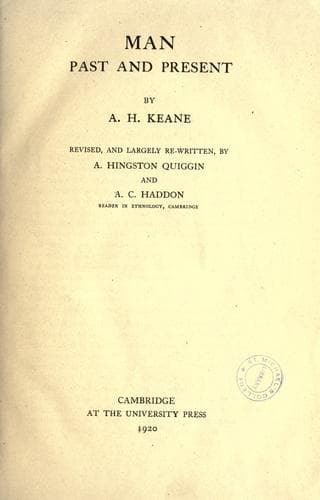
Man, Past and PresentKeane, A. H. (Augustus Henry)
History
Man, Past and Present
Keane, A. H. (Augustus Henry)
Anthropology; Ethnology
[233] J. Roscoe, _The Northern Bantu_, 1915, p. 103. Herein are also
described the _Bakene_, lake dwellers, the _Bagesu_, a cannibal tribe,
the _Basoga_ and the Nilotic tribes the _Bateso_ and _Kavirondo_.
[234] J. Roscoe, _loc. cit._ pp. 4, 5.
[235] "A Survey of the Ethnography of Africa," _Journ. Roy. Anthr.
Inst._ XLIII. 1913, p. 390.
[236] _Handwerk und Industrie in Ostafrika_, 1910, p. 147.
[237] "Die erste Ausbreitung des Menschengeschlechts." _Pol. Anthropol.
Revue_, 1909, p. 72. Cf. chronology on p. 14 above.
[238] _Ethnology_, p. 199.
[239] Uganda is the name now applied to the whole Protectorate, Buganda
is the small kingdom, Baganda, the people, Muganda, one person, Luganda,
the language. H. H. Johnston, _The Uganda Protectorate_, 1902, and J. F.
Cunningham, _Uganda and its Peoples_, 1905, cover much of the elementary
anthropology of East Central Africa.
[240] The legend is given with much detail by H. M. Stanley in _Through
the Dark Continent_, Vol. I. p. 344 sq. Another and less mythical
account of the migrations of "the people with a white skin from the far
north-east" is quoted from Emin Pasha by the Rev. R. P. Ashe in _Two
Kings of Uganda_, p. 336. Here the immigrant Ba-Hima are expressly
stated to have "adopted the language of the aborigines" (p. 337).
[241] Sir H. H. Johnston, _op. cit._ p. 514.
[242] Except the Lung-fish clan.
[243] J. Roscoe, _The Baganda_, 1911.
[244] For the _Wa-Kikuyu_ see W. S. and K. Routledge, _With a
Prehistoric People_, 1910, and C. W. Hobley's papers in the _Journ. Roy.
Anthr. Inst._ XL. 1910, and XLI. 1911. The _Atharaka_ are described by
A. M. Champion, _Journ. Roy. Anthr. Inst._ XLII. 1912, p. 68. Consult
for this region C. Eliot, _The East Africa Protectorate_, 1905; K.
Weule, _Native Life in East Africa_, 1909; C. W. Hobley, _Ethnology of
the A-Kamba and other East African Tribes_, 1910; M. Weiss, _Die
Voelkerstaemme im Norden Deutsch-Ostafrikas_, 1910; and A. Werner, "The
Bantu Coast Tribes of the East Africa Protectorate," _Journ. Roy. Anthr.
Inst._ XLV. 1915.
[245] _Official Report on the East African Protectorate_, 1897.
[246] _Vocabulary of the Giryama Language_, S.P.C.K. 1897.
[247] _Travels in the Coastlands of British East Africa_, London, 1898,
p. 103 sq.
[248] A. Werner, "Girijama Texts," _Zeitschr. f. Kol.-spr._ Oct. 1914.
[249] Having become the chief medium of intercourse throughout the
southern Bantu regions, Ki-swahili has been diligently cultivated,
especially by the English missionaries, who have wisely discarded the
Arab for the Roman characters. There is already an extensive literature,
including grammars, dictionaries, translations of the Bible and other
works, and even _A History of Rome_ issued by the S.P.C.K. in 1898.
Public-domain text, read in full here on John Shaqi.
Reviews
Reviews
No reviews yet
Be the first to share your thoughts on this work.
Elsewhere in the archive
Join the Discussion
Join the discussion
Sign in to leave a comment or review.
Sign InorCreate an account