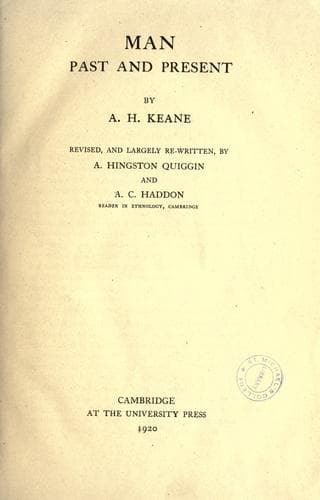
Man, Past and PresentKeane, A. H. (Augustus Henry)
History
Man, Past and Present
Keane, A. H. (Augustus Henry)
Anthropology; Ethnology
The origin of a dual organisation is generally believed to be due to
fission, but it is more reasonable to regard it as due to fusion, as
hostility is so frequently manifest between the two groups despite the
fact that spouses are always obtained from the other moiety. In New
Ireland (and elsewhere) each moiety is associated with a hero; one acts
wisely but unscrupulously, the other is a fool who is always falling an
easy victim to the first. Each moiety has a totem bird: one is a fisher,
clever and capable, while the second obtains its food by stealing from
the other and does not go to sea. One represents the immigrants of
superior culture who came by sea, the other the first people,
aborigines, of lowly culture who were quite unable to cope with the
wiles and stratagems of the people who had settled among them. In the
Gazelle Peninsula of New Britain, the dual groups are associated with
light and dark coconuts; affiliated with the former are male objects and
the clever bird, which is universally called _taragau_, or a variant of
that term. The bird of the other moiety is named _malaba_ or
_manigulai_, and is associated with female objects. The dark coconuts,
the dark colour and flattened noses of the women who were produced by
their transformation, and the projecting eyebrows of the _malaba_ bird
and its human adherents seem to be records in the mythology of the
Bismarck Archipelago of the negroid (or, Rivers suggests, an Australoid)
character of the aboriginal population. The light coconut which was
changed into a light-coloured woman seems to have preserved a tradition
of the light colour of the immigrants.
The autochthones of Melanesia were a dark-skinned and ulotrichous
people, who had neither a fear of the ghosts of their dead nor a manes
cult, but had a cult of local spirits. The Baining of the Gazelle
Peninsula of New Britain may be representatives of a stage of Melanesian
history earlier than the dual system; if so, they probably represent in
a modified form, the aboriginal element. They are said to be completely
devoid of any fear of the dead.
The immigrants whose arrival caused the institution of the dual system
were a relatively fair people of superior culture who interred their
dead in a sitting position and feared their ghosts. They first
introduced the Austronesian language.
All subsequent migrations were of Austronesian-speaking peoples from
Indonesia. First came the kava-peoples in various swarms, and more
recently the betel-people.
Public-domain text, read in full here on John Shaqi.
Reviews
Reviews
No reviews yet
Be the first to share your thoughts on this work.
Elsewhere in the archive
Join the Discussion
Join the discussion
Sign in to leave a comment or review.
Sign InorCreate an account