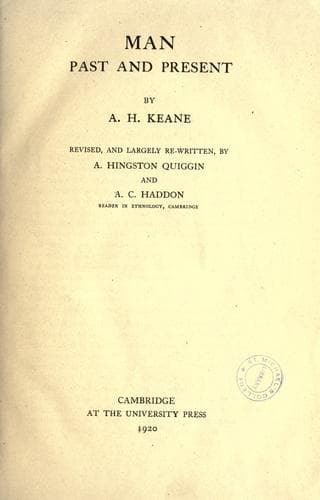
Man, Past and PresentKeane, A. H. (Augustus Henry)
History
Man, Past and Present
Keane, A. H. (Augustus Henry)
Anthropology; Ethnology
Possibly New Caledonia shows the effects of relative isolation more than
other parts of Melanesia, but, except for Polynesian influence (most
directly recognisable in Fiji and southern Melanesia), Melanesia may be
regarded as possessing a general culture with certain characteristic
features which may be thus summarised[335]. The Melanesians are a noisy,
excitable, demonstrative, affectionate, cheery, passionate people. They
could not be hunters everywhere, as in most of the islands there is no
game, nor could they be pastors anywhere, as there are no cattle; the
only resources are fishing and agriculture. In the larger islands there
is usually a sharp distinction between the coast people, who are mainly
fishers, and the inlanders who are agriculturalists; the latter are
always by far the more primitive, and in many cases are subservient to
the former. Both sexes work in the plantations. In parts of New Guinea
and the Western Solomons the sago palm is of great importance; coconut
palms grow on the shores of most islands, and bananas, yams,
bread-fruit, taro and sweet potatoes supply abundant food. As for dress,
the men occasionally wear none, but usually have belts or bands, of
bark-cloth, plaits, or strings, and the women almost everywhere have
petticoats of finely shredded leaves. The skin is decorated with scars
in various patterns, and tattooing is occasionally seen, the former
being naturally characteristic of the darker skinned people, and the
latter of the lighter. Every portion of the body is decorated in
innumerable ways with shells, teeth, feathers, leaves, flowers, and
other objects, and plaited bands encircle the neck, body, and limbs.
Shell necklaces, which constitute a kind of currency, and artificially
deformed boars' tusks are especially characteristic, though each group
usually has its peculiar ornaments, distinguishing it from any other
group. There is a great variety of houses. The typical Melanesian house
has a gable roof, the ridge pole is supported by two main posts, side
walls are very low, and the ends are filled in with bamboo screens. Pile
dwellings are found in the Bismarck Archipelago, the Solomon Islands and
New Guinea, and some New Guinea villages extend out into the sea.
The weapons typical of Melanesia are the club and the spear (though the
latter is not found in the Banks Islands), each group and often each
island possessing its own distinctive pattern. Stone headed clubs are
found in New Guinea, New Britain and the New Hebrides. The spears of the
Solomon Islands are finely decorated and have bone barbs; those of New
Caledonia are pointed with a sting-ray spine; those of the Admiralty
Islands have obsidian heads; and those of New Britain have a human
armbone at the butt end. The bow, the chief weapon of the Papuans,
occurs over the greater part of Melanesia, though it is absent in S.E.
New Guinea, and is only used for hunting in the Admiralty Islands.
Public-domain text, read in full here on John Shaqi.
Reviews
Reviews
No reviews yet
Be the first to share your thoughts on this work.
Elsewhere in the archive
Join the Discussion
Join the discussion
Sign in to leave a comment or review.
Sign InorCreate an account