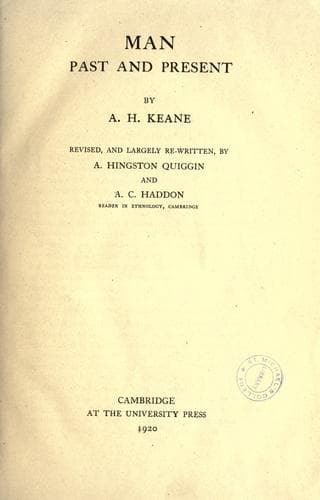
Man, Past and PresentKeane, A. H. (Augustus Henry)
History
Man, Past and Present
Keane, A. H. (Augustus Henry)
Anthropology; Ethnology
The hollowed out tree trunk with or without a plank gunwale is general,
usually with a single outrigger, though plank-built canoes occur in the
Solomons, characteristically ornamented with shell inlay. Pottery is an
important industry in parts of New Guinea and in Fiji; it occurs also in
New Caledonia, Espiritu Santo (New Hebrides) and the Admiralty Islands.
Bark-cloth is made in most islands, but a loom for weaving leaf strips
is now found only in Santa Cruz.
A division of the community into two exogamous groups is very widely
spread, no intermarriage being permitted within the group. Mother-right
is prevalent, descent and inheritance being counted on the mother's
side, while a man's property descends to his sister's children. At the
same time the mother is in no sense the head of the family; the house is
the father's, the garden may be his, the rule and government are his,
though the maternal uncle sometimes has more authority than the father.
The transition to father-right has definitely occurred in various
places, and is taking place elsewhere; thus, in some of the New
Hebrides, the father has to buy off the rights of his wife's relations
or his sister's children.
Chiefs exist everywhere, being endowed with religious sanctity in Fiji,
where they are regarded as the direct descendants of the tribal
ancestors. More often, a chief holds his position solely owing to the
fact that he has inherited the cult of some powerful spirit, and his
influence is not very extensive. Probably everywhere public affairs are
regulated by discussion among the old or important men, and the more
primitive the society, the more power they possess. But the most
powerful institutions of all are the secret societies, occurring with
certain exceptions throughout Melanesia. These are accessible to men
only, and the candidates on initiation have to submit to treatment which
is often rough in the extreme. The members of the societies are believed
to be in close association with ghosts and spirits, and exhibit
themselves in masks and elaborate dresses in which disguise they are
believed by the uninitiated to be supernatural beings. These societies
do not practise any secret cult, in fact all that the initiate appears
to learn is that the "ghosts" are merely his fellows in disguise, and
that the mysterious noises which herald their approach are produced by
the bull-roarer and other artificial means. These organisations are most
powerful agents for the maintenance of social order and inflict
punishment for breaches of customary law, but they are often terrorising
and blackmailing institutions. Women are rigorously excluded.
Public-domain text, read in full here on John Shaqi.
Reviews
Reviews
No reviews yet
Be the first to share your thoughts on this work.
Elsewhere in the archive
Join the Discussion
Join the discussion
Sign in to leave a comment or review.
Sign InorCreate an account